Monday, March 19, 2007


Thursday, March 15, 2007
HD RADIO-OFFENSIVE!
"HD Radio promises clarity and diversity. What it delivers is a whole different story."
"But after an investigation of HD Radio units, the stations playing HD, and the company that owns the technology; and some interviews with the wonks in DC, it looks like HD Radio is a high-level corporate scam, a huge carny shill."
"Welcome to New Radio, boys and girls. It stinks just like Old Radio, except the smell comes in clearer and there's more of it. Stay tuned."
CLICK ON THE TITLE ABOVE FOR THE REST OF THE STORY!
"But after an investigation of HD Radio units, the stations playing HD, and the company that owns the technology; and some interviews with the wonks in DC, it looks like HD Radio is a high-level corporate scam, a huge carny shill."
"Welcome to New Radio, boys and girls. It stinks just like Old Radio, except the smell comes in clearer and there's more of it. Stay tuned."
CLICK ON THE TITLE ABOVE FOR THE REST OF THE STORY!
Labels: HD Radio
Friday, January 05, 2007
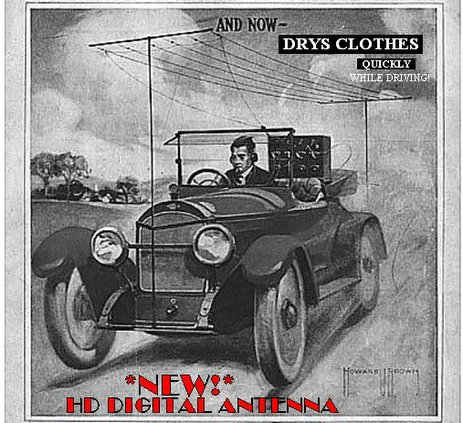
HD DIGITAL RADIO ANTENNA-DUEL USE!
Monday, January 01, 2007
HD RADIO FAILS TEST
According to reliable sources, a test, reported to Radio Shack, of their
Accurian Tabletop HD radio, failed to pick up a single HD Radio station reliably, anywhere indoors. HD reception totally failed in spite of using the extra supplied antennas, and with 17 HD radio stations nearby. Most stations broadcasting towers were so close as to be plainly visible from outside the test location. A second Accurian HD radio was tried, with similar results.
The normal (non-HD) AM and FM signals from all 17 stations were picked up crystal clear indoors, even without the extra antennas.
The building was a typical single story cinder block structure.
Accurian Tabletop HD radio, failed to pick up a single HD Radio station reliably, anywhere indoors. HD reception totally failed in spite of using the extra supplied antennas, and with 17 HD radio stations nearby. Most stations broadcasting towers were so close as to be plainly visible from outside the test location. A second Accurian HD radio was tried, with similar results.
The normal (non-HD) AM and FM signals from all 17 stations were picked up crystal clear indoors, even without the extra antennas.
The building was a typical single story cinder block structure.
2010-INTERNET BEATS BROADCAST RADIO!
According to:
http://www.bridgeratings.com/press_071906-digitalprojectionsupdwradio.htm
All forms of Internet Radio's total cume, incuding cell streaming from the internet, and podcasting by 2010 will equal:
Internet Radio 187.33 million
Wireless Internet 159.23 million
Mobile Phone Streaming (from internet) 11.81 million
Podcasting 3.95 million
TOTAL INTERNET CUME in 2010 = 362.32 million
While the terrestrial broadcast radio total cume is projected to be only: 278.59 million.
Internet cume beating terrestrial cume by 83.73 million by 2010.
That is only about 3 years from now!
HD Radio will only be at a miserable 8.84 million cume. Not enough to sustain thousands of HD stations. Evidence that HD Radio is just another dead end system, similar to several others that have gone before, and disappeared.
http://www.bridgeratings.com/press_071906-digitalprojectionsupdwradio.htm
All forms of Internet Radio's total cume, incuding cell streaming from the internet, and podcasting by 2010 will equal:
Internet Radio 187.33 million
Wireless Internet 159.23 million
Mobile Phone Streaming (from internet) 11.81 million
Podcasting 3.95 million
TOTAL INTERNET CUME in 2010 = 362.32 million
While the terrestrial broadcast radio total cume is projected to be only: 278.59 million.
Internet cume beating terrestrial cume by 83.73 million by 2010.
That is only about 3 years from now!
HD Radio will only be at a miserable 8.84 million cume. Not enough to sustain thousands of HD stations. Evidence that HD Radio is just another dead end system, similar to several others that have gone before, and disappeared.
Saturday, November 25, 2006
HD Radio-BUZZ OFF!
"The problem is this: unless you have a rock-solid, city-grade, right-near-the-tower signal, the HD either drops in and out or isn't there at all."
"Rock-solid, city-grade signal strength apparently isn't enough to hold the HD signal."
"what good is free if you can't get anything with it, or it drops in and out all the time?"
"They're selling the idea of the "HD2" and "HD3" subchannels for additional programming, but if you can't be assured of getting them without regular annoying dropouts, they're useless."
"Sell this to regular consumers who aren't in the business and aren't going to resort to extraordinary measures to pull in a signal and you're going to anger a lot of people- assuming, that is, that a lot of people will buy this thing, which isn't the case."
LEFT CLICK ON TITLE (ABOVE) FOR FULL STORY.
"Rock-solid, city-grade signal strength apparently isn't enough to hold the HD signal."
"what good is free if you can't get anything with it, or it drops in and out all the time?"
"They're selling the idea of the "HD2" and "HD3" subchannels for additional programming, but if you can't be assured of getting them without regular annoying dropouts, they're useless."
"Sell this to regular consumers who aren't in the business and aren't going to resort to extraordinary measures to pull in a signal and you're going to anger a lot of people- assuming, that is, that a lot of people will buy this thing, which isn't the case."
LEFT CLICK ON TITLE (ABOVE) FOR FULL STORY.
Saturday, November 11, 2006
HD RADIO-BILLION DOLLAR BOONDOGGLE?
FALSE CLAIMS AND INCOMPATIBLE RADIO JAMMING PLAGUE HD RADIO - PUT DIGITAL FUTURE OF DEFECTIVE HD RADIO SYSTEM IN DOUBT!
An engineering technical study presented by broadcast engineering expert Doug Vernier to the National Association of Broadcasters convention, Radio Engineering Session, Dallas, Texas, and Broadcasters Clinic, Madison, Wisconsin demonstrated massive radio interference created by the defective HD radio system.
Further engineering studies of HD radio are anticipated.
For the full engineering presentation, left click on the headline at top. Adobe Acrobat Reader, necessary, broadband internet preferred for faster download.
FALSE CLAIMS, COMPLAINTS, POOR PERFORMANCE, PROBLEMS, AND RADIO INTERFERENCE DOCUMENTED IN OTHER ARTICLES POSTED ON THIS BLOG.
An engineering technical study presented by broadcast engineering expert Doug Vernier to the National Association of Broadcasters convention, Radio Engineering Session, Dallas, Texas, and Broadcasters Clinic, Madison, Wisconsin demonstrated massive radio interference created by the defective HD radio system.
Further engineering studies of HD radio are anticipated.
For the full engineering presentation, left click on the headline at top. Adobe Acrobat Reader, necessary, broadband internet preferred for faster download.
FALSE CLAIMS, COMPLAINTS, POOR PERFORMANCE, PROBLEMS, AND RADIO INTERFERENCE DOCUMENTED IN OTHER ARTICLES POSTED ON THIS BLOG.
Sunday, November 05, 2006
HD Radio "It doesn't work"
"Guess what I didn’t see in AudioAdvisor's '07 catalog? You guessed it! So I called and asked one of their “consultants” about HD-Radio. He quickly replied, "You can special-order it on the net for $300, but nobody really wants them—besides, it doesn’t work... Can we sell you an XM home “reference” tuner?"
Link to full story:
http://www.radio-info.com/smf/index.php/topic,53173.msg370265.html#msg370265
Link to full story:
http://www.radio-info.com/smf/index.php/topic,53173.msg370265.html#msg370265
Tuesday, October 31, 2006
HD Radio-Truth from someone who bought the baloney!
HERE IS THE LATEST BUZZ ON HD RADIO, FROM ONE WHO BOUGHT ALL THE HYPE.
"The coverage seems to be only slightly more than HALF the coverage of the analog signal. "
"the difference between the digital and analog-stereo signal isn't that great. "
"as soon as I start moving, most stations' HD2 and HD3 signals drop off, and the HD1 signal reverts back to analog."
"As for AM-IBOC, their coverage seems to be even worse than FM. "
"In order to broadcast in HD, they had to scale back their analog signal to 5 or 6 KHz, and now there is no high end on any of the AM's running HD. Even the formerly great sounding WIBC now sounds muddy on the analog signal. In addition, the very things that cause interference on analog AM radios now disrupt the IBOC signal, causing the radio to blend back to analog, so where's the advantage?"
"the audio quality of all 4 AM-HD's is horrible."
"doesn't sound as good as streaming audio with a decent Internet connection."
"when WLW has the IBOC bandsaw turned on, it kills WGN"
CLICK ON THE TITLE (ABOVE) FOR THE FULL REVUE.
"The coverage seems to be only slightly more than HALF the coverage of the analog signal. "
"the difference between the digital and analog-stereo signal isn't that great. "
"as soon as I start moving, most stations' HD2 and HD3 signals drop off, and the HD1 signal reverts back to analog."
"As for AM-IBOC, their coverage seems to be even worse than FM. "
"In order to broadcast in HD, they had to scale back their analog signal to 5 or 6 KHz, and now there is no high end on any of the AM's running HD. Even the formerly great sounding WIBC now sounds muddy on the analog signal. In addition, the very things that cause interference on analog AM radios now disrupt the IBOC signal, causing the radio to blend back to analog, so where's the advantage?"
"the audio quality of all 4 AM-HD's is horrible."
"doesn't sound as good as streaming audio with a decent Internet connection."
"when WLW has the IBOC bandsaw turned on, it kills WGN"
CLICK ON THE TITLE (ABOVE) FOR THE FULL REVUE.
RATINGS DECLINE AS HD RADIO BUZZ SPREADS
STATIONS BROADCAST HD RADIO BUZZ & LOOSE RATINGS!
"WPEN did pretty lousy, garnering a paltry one-half share of male listeners ages 25 to 54. But WIP had its worst summer in years. The summer ratings were not kind to sports radio.
Michael Klein 10/19/06"
Ratings have been dropping since the sations began broadcasting loud HD Radio buzz on adjacent channels, cut fidelity in half, and added noise and hum to audio.
"Surprise! Surprise!" -Gomer Pyle USMC
Click on title (above) for source.
Check Arbitron link for Philadelphia, PA and your city to see if the addition High Destruction radio interference is eating into your local HD Radio station's ratings:
http://www1.arbitron.com/tlr/public/report.do;jsessionid=nSyAu3nBiLP+D6RzBrRpwg**.ppmappp
"WPEN did pretty lousy, garnering a paltry one-half share of male listeners ages 25 to 54. But WIP had its worst summer in years. The summer ratings were not kind to sports radio.
Michael Klein 10/19/06"
Ratings have been dropping since the sations began broadcasting loud HD Radio buzz on adjacent channels, cut fidelity in half, and added noise and hum to audio.
"Surprise! Surprise!" -Gomer Pyle USMC
Click on title (above) for source.
Check Arbitron link for Philadelphia, PA and your city to see if the addition High Destruction radio interference is eating into your local HD Radio station's ratings:
http://www1.arbitron.com/tlr/public/report.do;jsessionid=nSyAu3nBiLP+D6RzBrRpwg**.ppmappp
Sunday, October 29, 2006
HD Introduces "Pride Radio"
CLEAR CHANNEL INTRODUCES "PRIDE RADIO" HD FM STATION.
Finally out in the open, Clear Channel Communications announced "Pride Radio" on HD FM. The corporation is expected to change it's name to reflect it's new identity.
Click on title (above) to go to website and listen.
Here is the link to the press release:
http://www.clearchannel.com/Radio/PressRelease.aspx?PressReleaseID=1674&KeyWord=pride+radio
Finally out in the open, Clear Channel Communications announced "Pride Radio" on HD FM. The corporation is expected to change it's name to reflect it's new identity.
Click on title (above) to go to website and listen.
Here is the link to the press release:
http://www.clearchannel.com/Radio/PressRelease.aspx?PressReleaseID=1674&KeyWord=pride+radio
Thursday, October 26, 2006
HD Radio-R.I.P.
If you build it will they come?
During the NAB, iBiquity head Bob Struble reportedly indicated that there are "less than 100,000 HD radio chipsets sold" to date and, as has been much better publicized, 1,000 or so HD stations across the country.
Now let's make some assumptions.
First let's assume there's one chipset per radio.
Since 100,000 is a suspiciously round number, let's assume it's a round-up from 90,000 (likely a bit high).
Now let's assume 10,000 of these chipsets are in radios in the hands of broadcast industry professionals (perhaps a bit high).
Now let's assume 10,000 of these chipsets are in the manufacturing and distribution pipeline - not yet in radio form (perhaps a bit low).
Now let's assume 10,000 of these chipsets are in radios but locked in inventories.
That leaves a very, very rough estimate of 60,000 HD radios in the hands of consumers.
Or - 60 radios for every HD station on the air.
There is easily - easily - ten times that much audience listening to these "stations" on the web.
LEFT CLICK ON HEADLINE (ABOVE) FOR THE REST OF THE STORY.
During the NAB, iBiquity head Bob Struble reportedly indicated that there are "less than 100,000 HD radio chipsets sold" to date and, as has been much better publicized, 1,000 or so HD stations across the country.
Now let's make some assumptions.
First let's assume there's one chipset per radio.
Since 100,000 is a suspiciously round number, let's assume it's a round-up from 90,000 (likely a bit high).
Now let's assume 10,000 of these chipsets are in radios in the hands of broadcast industry professionals (perhaps a bit high).
Now let's assume 10,000 of these chipsets are in the manufacturing and distribution pipeline - not yet in radio form (perhaps a bit low).
Now let's assume 10,000 of these chipsets are in radios but locked in inventories.
That leaves a very, very rough estimate of 60,000 HD radios in the hands of consumers.
Or - 60 radios for every HD station on the air.
There is easily - easily - ten times that much audience listening to these "stations" on the web.
LEFT CLICK ON HEADLINE (ABOVE) FOR THE REST OF THE STORY.
Thursday, October 12, 2006
HD RADIO-THE INTERFERENCE FAR OUTWEIGHS THE LISTENER BENEFITS.
In an ideal world - HD Radio would have been birthed by engineers - inspired by Radio Programmers complaints that there wasn’t enough radio signals on which to bring all their great new programming ideas to life.
Instead- it was the opposite. HD was born as a technical achievement that attempts to answer questions no one was even asking.
Click on the headline (above) for the link to the rest of the article.
Instead- it was the opposite. HD was born as a technical achievement that attempts to answer questions no one was even asking.
Click on the headline (above) for the link to the rest of the article.
Sunday, October 08, 2006
HD RADIO-BUZZ INCREASES, AS LISTENERSHIP DECLINES
"Public radio trying to improve reception"
CLICK ON TITLE (ABOVE) FOR FULL STORY.
CLICK ON TITLE (ABOVE) FOR FULL STORY.
Wednesday, October 04, 2006
HD radio = "Junk technology"
"Consider the letter to Radio World from Robert Conrad (Reader's Forum, July 19), the president of Cleveland's classical WCLV(FM) and Seaway Productions, who complained that IBOC audio quality is not what was promised, and that signal coverage is terrible. I admire his courage. Most people in his position would be embarrassed to say that after having put so much of their money - and, in some cases, their prestige - behind this junk technology.
As Mr. Conrad said, broadcasters' efforts to promote IBOC "will only disappoint, and perhaps antagonize, a significant segment of the audience who find that the system doesn't deliver."
Let's hope the industry as a whole will recognize that IBOC has been a mistake, and that it does so soon enough that it will be only the larger broadcasters - and, I'm afraid, all too many financially strapped public broadcasters - who will have invested prematurely, and unwisely, in this ill-conceived technology. "
Click on the title above to link to the rest of the story.
"This dirty little secret"
"As a result, the lack of handheld HD Radio receivers - at least for the next few years - will keep the fledgling technology from becoming a player in the increasingly important portable audio industry. Given the strength and projected growth of that sector, this absence could have significant impact on HD Radio's success, as well as to the radio industry's overall relevance to future audiences."
Here is the link:
http://www.rwonline.com/pages/s.0054/t.359.html
As Mr. Conrad said, broadcasters' efforts to promote IBOC "will only disappoint, and perhaps antagonize, a significant segment of the audience who find that the system doesn't deliver."
Let's hope the industry as a whole will recognize that IBOC has been a mistake, and that it does so soon enough that it will be only the larger broadcasters - and, I'm afraid, all too many financially strapped public broadcasters - who will have invested prematurely, and unwisely, in this ill-conceived technology. "
Click on the title above to link to the rest of the story.
"This dirty little secret"
"As a result, the lack of handheld HD Radio receivers - at least for the next few years - will keep the fledgling technology from becoming a player in the increasingly important portable audio industry. Given the strength and projected growth of that sector, this absence could have significant impact on HD Radio's success, as well as to the radio industry's overall relevance to future audiences."
Here is the link:
http://www.rwonline.com/pages/s.0054/t.359.html
Saturday, September 30, 2006
HD RADIO-Bonanza for lobbyists.
In an on-going stepped-up effort to influence Capitol Hill, Rehr said the NAB “will use all of its tools to help educate legislators, our regulators and the public on how over-the-air radio is unique in offering compelling local programming. No competitor has this unique value proposition.”
Rehr also stressed the importance of the industry as a whole promoting HD Radio and encouraging the FCC to adopt HD rules and standards.
“Listeners want local content and connection,” Rehr figured.
The broadcast conglomerates have done virtually everything they can to elliminate as much local content and origination as possible, including laying off thousands of local employees, and networking, duplicating, and automating many of their stations.
CLICK ON THE TITLE (ABOVE) FOR THE REST OF THE STORY.
Rehr also stressed the importance of the industry as a whole promoting HD Radio and encouraging the FCC to adopt HD rules and standards.
“Listeners want local content and connection,” Rehr figured.
The broadcast conglomerates have done virtually everything they can to elliminate as much local content and origination as possible, including laying off thousands of local employees, and networking, duplicating, and automating many of their stations.
CLICK ON THE TITLE (ABOVE) FOR THE REST OF THE STORY.
Friday, September 15, 2006
FCC=FEDERAL CONCEALMENT COMMISSION
DECEPTION, MISDIRECTION, OBFUSCATION, CORRUPTION, ARE AGENCY AND ADMINISTRATION POLICIES.
FCC JUST ONE EXAMPLE.
"WASHINGTON - The Federal Communications Commission ordered its staff to destroy all copies of a draft study that suggested greater concentration of media ownership would hurt local TV news coverage, a former lawyer at the agency says.
The report, written in 2004, came to light during the Senate confirmation hearing for FCC Chairman Kevin Martin.
Sen. Barbara Boxer, D-Calif. received a copy of the report "indirectly from someone within the FCC who believed the information should be made public," according to Boxer spokeswoman Natalie Ravitz."
"'Every last piece' destroyedAdam Candeub, now a law professor at Michigan State University, said senior managers at the agency ordered that "every last piece" of the report be destroyed. "The whole project was just stopped - end of discussion," he said. Candeub was a lawyer in the FCC's Media Bureau at the time the report was written and communicated frequently with its authors, he said.
In a letter sent to Martin Wednesday, Boxer said she was "dismayed that this report, which was done at taxpayer expense more than two years ago, and which concluded that localism is beneficial to the public, was shoved in a drawer."
Martin said he was not aware of the existence of the report, nor was his staff. His office indicated it had not received Boxer's letter as of midafternoon Thursday.
Local ownership benefitsIn the letter, Boxer asked whether any other commissioners "past or present" knew of the report's existence and why it was never made public. She also asked whether it was "shelved because the outcome was not to the liking of some of the commissioners and/or any outside powerful interests?"
The report, written by two economists in the FCC's Media Bureau, analyzed a database of 4,078 individual news stories broadcast in 1998. The broadcasts were obtained from Danilo Yanich, a professor and researcher at the University of Delaware, and were originally gathered by the Pew Foundation's Project for Excellence in Journalism.
The analysis showed local ownership of television stations adds almost five and one-half minutes of total news to broadcasts and more than three minutes of "on-location" news. The conclusion is at odds with FCC arguments made when it voted in 2003 to increase the number of television stations a company could own in a single market. It was part of a broader decision liberalizing ownership rules.
Community responsivenessAt that time, the agency pointed to evidence that "commonly owned television stations are more likely to carry local news than other stations."
When considering whether to loosen rules on media ownership, the agency is required to examine the impact on localism, competition and diversity. The FCC generally defines localism as the level of responsiveness of a station to the needs of its community."
Click on title (above) for link to full article.
Also:
http://www.freepress.net/news/17682
http://www.freepress.net/payola/
This is a direct link to the shredded document on media ownership:
http://svartifoss2.fcc.gov/prod/ecfs/retrieve.cgi?native_or_pdf=pdf&id_document=6518462392
FCC reply letter:
http://hraunfoss.fcc.gov/edocs_public/attachmatch/DOC-267475A1.pdf
FCC JUST ONE EXAMPLE.
"WASHINGTON - The Federal Communications Commission ordered its staff to destroy all copies of a draft study that suggested greater concentration of media ownership would hurt local TV news coverage, a former lawyer at the agency says.
The report, written in 2004, came to light during the Senate confirmation hearing for FCC Chairman Kevin Martin.
Sen. Barbara Boxer, D-Calif. received a copy of the report "indirectly from someone within the FCC who believed the information should be made public," according to Boxer spokeswoman Natalie Ravitz."
"'Every last piece' destroyedAdam Candeub, now a law professor at Michigan State University, said senior managers at the agency ordered that "every last piece" of the report be destroyed. "The whole project was just stopped - end of discussion," he said. Candeub was a lawyer in the FCC's Media Bureau at the time the report was written and communicated frequently with its authors, he said.
In a letter sent to Martin Wednesday, Boxer said she was "dismayed that this report, which was done at taxpayer expense more than two years ago, and which concluded that localism is beneficial to the public, was shoved in a drawer."
Martin said he was not aware of the existence of the report, nor was his staff. His office indicated it had not received Boxer's letter as of midafternoon Thursday.
Local ownership benefitsIn the letter, Boxer asked whether any other commissioners "past or present" knew of the report's existence and why it was never made public. She also asked whether it was "shelved because the outcome was not to the liking of some of the commissioners and/or any outside powerful interests?"
The report, written by two economists in the FCC's Media Bureau, analyzed a database of 4,078 individual news stories broadcast in 1998. The broadcasts were obtained from Danilo Yanich, a professor and researcher at the University of Delaware, and were originally gathered by the Pew Foundation's Project for Excellence in Journalism.
The analysis showed local ownership of television stations adds almost five and one-half minutes of total news to broadcasts and more than three minutes of "on-location" news. The conclusion is at odds with FCC arguments made when it voted in 2003 to increase the number of television stations a company could own in a single market. It was part of a broader decision liberalizing ownership rules.
Community responsivenessAt that time, the agency pointed to evidence that "commonly owned television stations are more likely to carry local news than other stations."
When considering whether to loosen rules on media ownership, the agency is required to examine the impact on localism, competition and diversity. The FCC generally defines localism as the level of responsiveness of a station to the needs of its community."
Click on title (above) for link to full article.
Also:
http://www.freepress.net/news/17682
http://www.freepress.net/payola/
This is a direct link to the shredded document on media ownership:
http://svartifoss2.fcc.gov/prod/ecfs/retrieve.cgi?native_or_pdf=pdf&id_document=6518462392
Thanks for the tip. The public should be greatful for disclosure of this deception."Senator Barbara Boxer has posted the text of the FCC's shredded study in FCC
Docket 06-121 on the FCC Electronic Comment Filing System (ECFS). http://www.fcc.gov/cgb/ecfs/ecfs_alt.html>>
This 24-page document was posted on September 12th. Listed below is a
citation of her filing.
I have requested an extension of time for public
comment on this apparently suppressed study of media ownership
rules.
Nickolaus E. Leggett"
FCC reply letter:
http://hraunfoss.fcc.gov/edocs_public/attachmatch/DOC-267475A1.pdf
Thursday, September 14, 2006
RADIO LISTENING-DECLINING TREND
ARBITRON SHOWS RADIO LISTENING DECLINING.
COMPETITION FROM NEW MEDIA, PERHAPS?
CLICK ON HEADLINE (ABOVE) FOR LINK TO ARBITRON REPORT.
COMPETITION FROM NEW MEDIA, PERHAPS?
CLICK ON HEADLINE (ABOVE) FOR LINK TO ARBITRON REPORT.
"RADIO CONSOLIDATION~DOING IRREPERABLE HARM"
"Consolidation of media ownership is doing irreparable harm to local and national news coverage, and thus to the key fabric of democracy in our country," said John Connolly, President of the American Federal Of Television & Radio Artists at an FCC Town Hall Meeting in Los Angeles conducted by FCC Commissioners Jonathan Adelstein and Michael Copps yesterday.
"By allowing the reduction of outlets for diverse opinions via the concentration of power in fewer and fewer corporate hands, the Federal Communications Commission condemns Americans to a country where the public interest suffers, democracy suffers, and working people suffer," said Connolly. "AFTRA members oppose the continued de-regulation of the media and entertainment industries--and the resulting continued concentration of ownership in fewer hands. We urge the commission to protect and enhance the fundamental right and public interest of the American people as true owners of the airwaves."
"By allowing the reduction of outlets for diverse opinions via the concentration of power in fewer and fewer corporate hands, the Federal Communications Commission condemns Americans to a country where the public interest suffers, democracy suffers, and working people suffer," said Connolly. "AFTRA members oppose the continued de-regulation of the media and entertainment industries--and the resulting continued concentration of ownership in fewer hands. We urge the commission to protect and enhance the fundamental right and public interest of the American people as true owners of the airwaves."
Thursday, September 07, 2006
HD Radio: too little, too late-DOA
"Face it, folks...when you add it up, HD Radio as a platform will never be competitive with satellite or Internet radio on a value for value basis for the end user."
http://heartsofspace.typepad.com/spatialrelations/
"Mark,
Your observations about the strange disconnect between industry spin and the realities HD radio is facing are all correct, but you politely stop short of the obvious conclusion: HD is DOA.
The only reason it has gotten this far is that such an amazing amount of time and money has been invested in it by iBiquity, with support from radio industry stakeholders and receiver manufacturers.
Many radio folk were skeptical from the beginning. Promoting HD as a quality upgrade (source of the HD moniker) was obviously bull — the typical Internet music stream is already higher quality than HD and can be upgraded easily as deliverable bandwidth gets cheaper. HD reminds me of DCC (Digital Compact Cassette), another attempt by a mature industry to administer life support to a sunset format. That didn't work either, and today almost no one even remembers it.
Promoting the increase in channels on HD sounded good until the usage reports came in and it became clear that with an IBOC system there really wasn't enough additional bandwidth on AM and FM to do the job properly. The U.S. really needed microwave digital radio spectrum like they got in Europe, so new radios could simply add a band. And nobody really figured out where the money would come from to staff and operate those new channels at an effective level, even if they actually worked technically.
And then there was the little matter of the hardware upgrade...it might have had a shot if the Internet wasn't evolving several orders of magnitude faster, the FCC approval happened three times faster, the manufacturers were more agile, and the public had a clear reason to do it. But of course none of these conditions were met and today we still have the ~$500 standalone HD radio and the ~$250 upgrade fee for a new car radio."
http://heartsofspace.typepad.com/spatialrelations/2006/07/index.html
http://www.radio-info.com/smf/index.php/topic,46784.0.html
http://heartsofspace.typepad.com/spatialrelations/
"Mark,
Your observations about the strange disconnect between industry spin and the realities HD radio is facing are all correct, but you politely stop short of the obvious conclusion: HD is DOA.
The only reason it has gotten this far is that such an amazing amount of time and money has been invested in it by iBiquity, with support from radio industry stakeholders and receiver manufacturers.
Many radio folk were skeptical from the beginning. Promoting HD as a quality upgrade (source of the HD moniker) was obviously bull — the typical Internet music stream is already higher quality than HD and can be upgraded easily as deliverable bandwidth gets cheaper. HD reminds me of DCC (Digital Compact Cassette), another attempt by a mature industry to administer life support to a sunset format. That didn't work either, and today almost no one even remembers it.
Promoting the increase in channels on HD sounded good until the usage reports came in and it became clear that with an IBOC system there really wasn't enough additional bandwidth on AM and FM to do the job properly. The U.S. really needed microwave digital radio spectrum like they got in Europe, so new radios could simply add a band. And nobody really figured out where the money would come from to staff and operate those new channels at an effective level, even if they actually worked technically.
And then there was the little matter of the hardware upgrade...it might have had a shot if the Internet wasn't evolving several orders of magnitude faster, the FCC approval happened three times faster, the manufacturers were more agile, and the public had a clear reason to do it. But of course none of these conditions were met and today we still have the ~$500 standalone HD radio and the ~$250 upgrade fee for a new car radio."
http://heartsofspace.typepad.com/spatialrelations/2006/07/index.html
http://www.radio-info.com/smf/index.php/topic,46784.0.html
Sunday, August 20, 2006
HD Radio-IS JAMMING YOUR AM/FM RADIO
HD RADIO CAUSES NOISE, BUZZ, HISS, HASH AND JAMMING OF OTHER STATIONS ON BOTH AM AND FM ANALOG RADIOS.
HD Radio uses more then twice the dial space as analog, and adds digital noise and interference to each side of an HD stations signal.
Here is the link to the graphic proof:
http://www.elecdesign.com/Files/29/12194/Figure_02.gif
HD Radio uses more then twice the dial space as analog, and adds digital noise and interference to each side of an HD stations signal.
Here is the link to the graphic proof:
http://www.elecdesign.com/Files/29/12194/Figure_02.gif
Thursday, August 17, 2006
HD Radio is DOA -HERE IS WHAT'S HOT! Super Sound of the Future.
HD Radio-Too little, to late, and too many broken promises.
http://www.podcastingnews.com/archives/2006/07/public_radio_gu.html
http://www.synthtopia.com/news/06_08/Stephen_Hill_Digital_Radi.html
Link to hundreds of new stations, true CD quality sound, totally free (not even an expensive new radio is required), 5.1 digital surround sound, everything that HD Radio promises, but does not deliver.
Hear the sound of the future:
http://www.tuner2.com/
If you already have the latest version of winmp (www.winamp.com) or Windows Media AAC+ plugin, here are more AAC+ and high bitrate stations for FREE Super HD:
http://www.shoutcast.com/directory/?s=AAC%2B
http://www.podcastingnews.com/archives/2006/07/public_radio_gu.html
http://www.synthtopia.com/news/06_08/Stephen_Hill_Digital_Radi.html
Link to hundreds of new stations, true CD quality sound, totally free (not even an expensive new radio is required), 5.1 digital surround sound, everything that HD Radio promises, but does not deliver.
Hear the sound of the future:
http://www.tuner2.com/
If you already have the latest version of winmp (www.winamp.com) or Windows Media AAC+ plugin, here are more AAC+ and high bitrate stations for FREE Super HD:
http://www.shoutcast.com/directory/?s=AAC%2B
FREE HD TUNER AND STATIONS!
DOWNLOAD THE LATEST VERSION OF WINAMP OR WINDOWS MEDIA PLAYER 10 PLUG-IN TO GET HUNDREDS OF NEW HD STATIONS INCLUDING 5.1 SURROUND SOUND!
Here is the link:
http://www.tuner2.com/
Uses AAC Plus codec by Coding Technologies. The same codec as HD Radio, but, in many cases, at a much higher quality and bitrate.
Here is the link:
http://www.tuner2.com/
Uses AAC Plus codec by Coding Technologies. The same codec as HD Radio, but, in many cases, at a much higher quality and bitrate.
Sunday, August 13, 2006
HD Radio-TECHNICAL INFO. FOR ENGINEERS
HERE ARE LINKS FOR RADIO ENGINEERS AND OTHER TECHNICALLY MINDED INDIVIDUALS ABOUT AM RADIO HD - IBOC, AND RELATED INFORMATION.
http://topazdesigns.com/iboc/AM-IBOC-Parameters.html
HD RADIO IBOC AM STATIONS INCLUDING THOSE THAT TRIED HD RADIO AND ARE NOW or have been HD SILENT:
http://topazdesigns.com/iboc/station-list.html
AM CHANNEL LOOKUP PAGE INCLUDING HD STATIONS (IN RED):
http://topazdesigns.com/ambc/
http://topazdesigns.com/iboc/AM-IBOC-Parameters.html
HD RADIO IBOC AM STATIONS INCLUDING THOSE THAT TRIED HD RADIO AND ARE NOW or have been HD SILENT:
http://topazdesigns.com/iboc/station-list.html
AM CHANNEL LOOKUP PAGE INCLUDING HD STATIONS (IN RED):
http://topazdesigns.com/ambc/
Thursday, August 10, 2006
HD Radio-GET IT FREE OVER THE INTERNET!
MOST HD RADIO STATIONS ARE AVAILABLE STREAMING OVER THE INTERNET!
No need for an HD Radio as the station's websites usually give webstreams of their HD content. You can also listen for free to most XM stations and hundreds of others stations on AOL Radio, which is now FREE!
http://music.aol.com/radioguide/bb.adp
"NPR radio store www.npr.com sells so many of the Acoustic Energy wireless WI-FI Internet radios in their online store that they can hardly keep them in stock. In spite of all the promotion and hype about HD Radio, the NPR store does not seem to carry HD Radios. Internet radio seems likely to be the clear winner."
http://shop.npr.org/webapp/wcs/stores/servlet/TopCategoriesDisplay?storeId=10051&catalogId=10051
No need for an HD Radio as the station's websites usually give webstreams of their HD content. You can also listen for free to most XM stations and hundreds of others stations on AOL Radio, which is now FREE!
http://music.aol.com/radioguide/bb.adp
"NPR radio store www.npr.com sells so many of the Acoustic Energy wireless WI-FI Internet radios in their online store that they can hardly keep them in stock. In spite of all the promotion and hype about HD Radio, the NPR store does not seem to carry HD Radios. Internet radio seems likely to be the clear winner."
http://shop.npr.org/webapp/wcs/stores/servlet/TopCategoriesDisplay?storeId=10051&catalogId=10051
HD Radio-More comments
"In a side-by-side comparison, I gotta be honest with you: I can't tell the difference between the digital and the analog."
"I'm not surprised. The audio quality difference between HD FM and analog FM isn't very noticeable."
"I've thought about what I actually heard myself and what I was told by someone else and have come to the following conclusion: When one gets far enough from the transmitting tower where the analog signal is noisy and the digital signal would be a definite plus, the digital signal isn't even there."
"I can tell you right now that the digital signal doesn't travel anywhere near as far as the analogue. Detroit stations right now are having a terrible time trying to push their digital sub-channels because even the inner suburbs are having problems receiving them."
"Since your post, I've heard similar stories from techs in other markets."
"That would be my experience. If the HD signal is strong enough to decode, the analog signal is strong enough to be noise-free. That goes for AM too, even more so than for FM."
HD Radio is DOA (Dead On Arrival)
Link to full posts:
http://www.radio-info.com/smf/index.php/topic,40512.0.html
"I'm not surprised. The audio quality difference between HD FM and analog FM isn't very noticeable."
"I've thought about what I actually heard myself and what I was told by someone else and have come to the following conclusion: When one gets far enough from the transmitting tower where the analog signal is noisy and the digital signal would be a definite plus, the digital signal isn't even there."
"I can tell you right now that the digital signal doesn't travel anywhere near as far as the analogue. Detroit stations right now are having a terrible time trying to push their digital sub-channels because even the inner suburbs are having problems receiving them."
"Since your post, I've heard similar stories from techs in other markets."
"That would be my experience. If the HD signal is strong enough to decode, the analog signal is strong enough to be noise-free. That goes for AM too, even more so than for FM."
HD Radio is DOA (Dead On Arrival)
Link to full posts:
http://www.radio-info.com/smf/index.php/topic,40512.0.html
Saturday, August 05, 2006
HD Radio-COMMENTS
HD Radio is DOA (Dead On Arrival)
Posted by: George June 16, 2006 at 08:17 AM
HD is DOA. I'm a bit of a radio geek and early adopter, and buying an HD radio doesn't interest me in the least.
Looks to me like the friut is dead on the vine based on the lack of progress with product rollout and "content".
Posted by: tim wallick June 16, 2006 at 01:51 PM
I think it is fair to say that the audiophile community, those people who take their FM seriously, is dead set AGAINST HDRadio.
Not only do most people never intend to buy a radio, unless as a plaything for early adopters and collectors, but are aghast at the FCC for even allowing IBOC to thrash up the FM bandwidth.
Plus, people with enough technical savvy to read the specs are insulted by the false claims of "CD sound quality" or even "near-CD sound quality." These are transparent marketing hype, beyond mean puffery.
Sorry, but HDRadio has sworn enemies. This goes beyond just business but has political reprecussions for FCC and for Congress. This has the whiff of political scandal - and I'm a rock-ribbed Republican! The Corporation for Public Broadcasting is especially vulnerable.
My advice for any businessman is to avoid any association with HDRadio.
There are a couple of other benefits for HDRadio: it effective blocks listeners from tuning in suburban stations on adjacent frequencies (an HD station on 92.9 can occupy 92.7 and 93.1 with its digital hash), and it basically locks out LPFMs, programmed translators, and other threats to the FM spectrum.
Posted by: MattS June 18, 2006 at 05:49 AM
Here is the rest of the story:
http://www.hear2.com/2006/06/hd_radio_fun_wi.html
At times, tuning in digital radio reminded me of trying to lock in digital TV broadcasts. The signals were weaker than their analog counterparts, as mandated by Federal Communications Commission regulations, and could drop out, then resume for no apparent reason. The HD signals of classical WGMS (104.1 FM) and smooth-jazz WJZW (105.9 FM) never got past that shakiness -- and The Post's WTWP (107.7 FM) was complete static the whole time.
HD radio on AM delivers a much bigger improvement in sound -- but only if you can get the signal, something the Recepter had serious trouble doing. Whether I used its internal AM antenna or the external one included in the box, it pulled in only one HD AM signal, "SportsTalk" WTEM (980 AM). It detected an HD signal on two others, WKDL (730 AM) and WTWP (1500 AM), but never tuned it in; all-talk WTNT (570 AM) never even showed one.
Here is the link:
http://www.washingtonpost.com/wp-dyn/content/article/2006/04/29/AR2006042900245.html
Posted by: George June 16, 2006 at 08:17 AM
HD is DOA. I'm a bit of a radio geek and early adopter, and buying an HD radio doesn't interest me in the least.
Looks to me like the friut is dead on the vine based on the lack of progress with product rollout and "content".
Posted by: tim wallick June 16, 2006 at 01:51 PM
I think it is fair to say that the audiophile community, those people who take their FM seriously, is dead set AGAINST HDRadio.
Not only do most people never intend to buy a radio, unless as a plaything for early adopters and collectors, but are aghast at the FCC for even allowing IBOC to thrash up the FM bandwidth.
Plus, people with enough technical savvy to read the specs are insulted by the false claims of "CD sound quality" or even "near-CD sound quality." These are transparent marketing hype, beyond mean puffery.
Sorry, but HDRadio has sworn enemies. This goes beyond just business but has political reprecussions for FCC and for Congress. This has the whiff of political scandal - and I'm a rock-ribbed Republican! The Corporation for Public Broadcasting is especially vulnerable.
My advice for any businessman is to avoid any association with HDRadio.
There are a couple of other benefits for HDRadio: it effective blocks listeners from tuning in suburban stations on adjacent frequencies (an HD station on 92.9 can occupy 92.7 and 93.1 with its digital hash), and it basically locks out LPFMs, programmed translators, and other threats to the FM spectrum.
Posted by: MattS June 18, 2006 at 05:49 AM
Here is the rest of the story:
http://www.hear2.com/2006/06/hd_radio_fun_wi.html
At times, tuning in digital radio reminded me of trying to lock in digital TV broadcasts. The signals were weaker than their analog counterparts, as mandated by Federal Communications Commission regulations, and could drop out, then resume for no apparent reason. The HD signals of classical WGMS (104.1 FM) and smooth-jazz WJZW (105.9 FM) never got past that shakiness -- and The Post's WTWP (107.7 FM) was complete static the whole time.
HD radio on AM delivers a much bigger improvement in sound -- but only if you can get the signal, something the Recepter had serious trouble doing. Whether I used its internal AM antenna or the external one included in the box, it pulled in only one HD AM signal, "SportsTalk" WTEM (980 AM). It detected an HD signal on two others, WKDL (730 AM) and WTWP (1500 AM), but never tuned it in; all-talk WTNT (570 AM) never even showed one.
Here is the link:
http://www.washingtonpost.com/wp-dyn/content/article/2006/04/29/AR2006042900245.html
HD Radio-DEFECTIVE TECHNOLOGY-WHAT USERS SAY
don't fall for the hype
Written by mrcomment, Las Vegas on July 14, 2005
Disappointing & pricey.Digital range is less than analog.Digital AM has horrible artifacts.Digital FM wipes out rimshot stations.Digital FM makes multipath worse.Gen#1 receivers don't work with multicast audio.Current receiver won't pick up future surround sound.
HD Radio HypeWritten by Toby Williams, Santa Clara, CA on June 16, 2005
I was terribly disappointed with the Kenwood HD tuner. It's probably an okay product, but HD radio itself is not.Several San Francisco area stations are sending HD radio. Unfortunately I get a lot of digital breakup when I listen to HD radio while driving around. The analog signals are all fine. The audio quality doesn't seem to be any better than the analog. It seems very compressed and doesn't sound like a CD at all. It might sound a little better than my XM radio, but not much. Don't waste your money on HD radio. I thought I was going to get more program choices, but that's not the case. I get the same old stuff, and it doesn't really sound enough better to justify the expense. I'm not sure what I was thinking when I put my money down for this tuner. I'll stick with XM.Toby Williams
Written by Timothy, Newport, Mi on July 15, 2006
tuner gets terrible reception, hd fades in and out at only 28 miles from detroit, had to reset the balance every time i started my truck, very disappointed with this unit, sent it back for another brand.
Junk compared to original recepter radio
by Jerry747 - May 2, 2006
Pros:
Second speaker, hd capable
Cons:
Nonexistant fm tuner sensitivity, ridiculous power brick.
The disappointments are weak treble, poor sensitivity in AM and FM (the inexpensive Sony "shelf system" that it replaced has much better FM sensitivity), and the inability to force to analog mode. The latter is not much of a problem here as even in this large metro area (Baltimore-Washington), there are only a few HD stations in range; I can't receive Washington stations, about 40 miles away.
Had a chance to use this radio for awhile. Im not really sure about the glowing reviews I keep reading for it here. Im more with the guy who said its just as worse as a regular radio cause I cant get no reception in my office either. "HD" indeed.
There should be the ability to keep the station in analog mode, in the event the digital signal is marginal. Otherwise, the radio blends in and out of digital mode, and if the station is not utilizing the 8.4 second delay in their analog signal, the audio jumps back and forth like a skipping CD player.
It takes about 5 seconds after you tune-in to a station for the radio to acquire the digital signal (it instantly acquires the analog signal). There is no analog version for the additional digital channels, so you hear about 5 seconds of nothing before the radio tunes-in to one of these channels.
So it sounds like good FM not CD quality audio.
The reception is lousy though. I can't pick up any HD Radio stations in my office and it is worse than my analog radio for regular stations. Also seems to get stuck when I press too many buttons. Save your money and buy several year's worth of XM or Sirius.
hd limitations
Written by teery, kokomo, in on February 9, 2006
i live about 50 miles from several HD transmitters. i purchased the HD tuner for am reception. my experiance was disappointing and ive returned my tuner and radio. i travel over a wide area of central indiana and the HD signal was intermittant even though the signal was strong. 50,000 watt wibc signal is clear during daylight hours, however the HD signal would come and go and as a result there was a 2 second delay which drives you crazy. the signal kept shifting from HD to analog. also wnde signal is broadcast in HD but you have to be with 25 miles of the transmitter for it to work effectively even though the analog signal is clear for 50 miles. this defeats the purpose of the HD radio as i was trying to eleminate drift and interference. the bottom line is that the HD signal strength is much weaker than the analog signal. so, the HD tuner is only functioal for a limited range. also, when you attach the tuner you can no longer dial up weaker distant stations manualy. if you live near a major metropolitan area the HD radio is great. if you travel 25-50 away from the transmitter you really dont have HD capability anymore.
By: James P., Somich 05/26/06Overall rating: The Receptor HD is a good example of an "early adopter" product. It is a good idea, not quite ready for prime time. The sensitivity in the HD mode leaves a lot to be desired. I had to use a rooftop antenna to pickup local HD stations. The price is way too high for what it is, but that is to be expected with a brand new product like this. The sound tends to be on the bassy side (which some people may like). This is certainly not high fidelity and it is certainly not CD quality. The miniscule data rates for HD radio permit only an "acceptable" sound quality. This is a good start, but HD radio has a long way to go before it will be accepted by the masses.
Here is the link:
www.radioshack.com
Ease of useValueReliabilityPerformance
Written by mrcomment, Las Vegas on July 14, 2005
Disappointing & pricey.Digital range is less than analog.Digital AM has horrible artifacts.Digital FM wipes out rimshot stations.Digital FM makes multipath worse.Gen#1 receivers don't work with multicast audio.Current receiver won't pick up future surround sound.
HD Radio HypeWritten by Toby Williams, Santa Clara, CA on June 16, 2005
I was terribly disappointed with the Kenwood HD tuner. It's probably an okay product, but HD radio itself is not.Several San Francisco area stations are sending HD radio. Unfortunately I get a lot of digital breakup when I listen to HD radio while driving around. The analog signals are all fine. The audio quality doesn't seem to be any better than the analog. It seems very compressed and doesn't sound like a CD at all. It might sound a little better than my XM radio, but not much. Don't waste your money on HD radio. I thought I was going to get more program choices, but that's not the case. I get the same old stuff, and it doesn't really sound enough better to justify the expense. I'm not sure what I was thinking when I put my money down for this tuner. I'll stick with XM.Toby Williams
Written by Timothy, Newport, Mi on July 15, 2006
tuner gets terrible reception, hd fades in and out at only 28 miles from detroit, had to reset the balance every time i started my truck, very disappointed with this unit, sent it back for another brand.
Junk compared to original recepter radio
by Jerry747 - May 2, 2006
Pros:
Second speaker, hd capable
Cons:
Nonexistant fm tuner sensitivity, ridiculous power brick.
The disappointments are weak treble, poor sensitivity in AM and FM (the inexpensive Sony "shelf system" that it replaced has much better FM sensitivity), and the inability to force to analog mode. The latter is not much of a problem here as even in this large metro area (Baltimore-Washington), there are only a few HD stations in range; I can't receive Washington stations, about 40 miles away.
Had a chance to use this radio for awhile. Im not really sure about the glowing reviews I keep reading for it here. Im more with the guy who said its just as worse as a regular radio cause I cant get no reception in my office either. "HD" indeed.
There should be the ability to keep the station in analog mode, in the event the digital signal is marginal. Otherwise, the radio blends in and out of digital mode, and if the station is not utilizing the 8.4 second delay in their analog signal, the audio jumps back and forth like a skipping CD player.
It takes about 5 seconds after you tune-in to a station for the radio to acquire the digital signal (it instantly acquires the analog signal). There is no analog version for the additional digital channels, so you hear about 5 seconds of nothing before the radio tunes-in to one of these channels.
So it sounds like good FM not CD quality audio.
The reception is lousy though. I can't pick up any HD Radio stations in my office and it is worse than my analog radio for regular stations. Also seems to get stuck when I press too many buttons. Save your money and buy several year's worth of XM or Sirius.
hd limitations
Written by teery, kokomo, in on February 9, 2006
i live about 50 miles from several HD transmitters. i purchased the HD tuner for am reception. my experiance was disappointing and ive returned my tuner and radio. i travel over a wide area of central indiana and the HD signal was intermittant even though the signal was strong. 50,000 watt wibc signal is clear during daylight hours, however the HD signal would come and go and as a result there was a 2 second delay which drives you crazy. the signal kept shifting from HD to analog. also wnde signal is broadcast in HD but you have to be with 25 miles of the transmitter for it to work effectively even though the analog signal is clear for 50 miles. this defeats the purpose of the HD radio as i was trying to eleminate drift and interference. the bottom line is that the HD signal strength is much weaker than the analog signal. so, the HD tuner is only functioal for a limited range. also, when you attach the tuner you can no longer dial up weaker distant stations manualy. if you live near a major metropolitan area the HD radio is great. if you travel 25-50 away from the transmitter you really dont have HD capability anymore.
By: James P., Somich 05/26/06Overall rating: The Receptor HD is a good example of an "early adopter" product. It is a good idea, not quite ready for prime time. The sensitivity in the HD mode leaves a lot to be desired. I had to use a rooftop antenna to pickup local HD stations. The price is way too high for what it is, but that is to be expected with a brand new product like this. The sound tends to be on the bassy side (which some people may like). This is certainly not high fidelity and it is certainly not CD quality. The miniscule data rates for HD radio permit only an "acceptable" sound quality. This is a good start, but HD radio has a long way to go before it will be accepted by the masses.
Here is the link:
www.radioshack.com
Ease of useValueReliabilityPerformance
Monday, July 31, 2006
Wireless World Wide Web Wins the Radio battle! JUST SAY NO-TO HD RADIO!
World Wide Web Wireless Radio projected to win the Radio Wars!
Forcast by 2010-
Less than 8 million podcast listeners- Just under 9 million HD radio listeners- About 36 million satellte radio listeners- About 21 million folks who listen to their "radio" on their mobile phones- Almost 190 million Internet radio listeners (!!)
And here is their editorial clincher:
According to this updated data, the entire spectrum of digital audio alternatives, and especially Internet radio and its wireless distribution continue to represent the biggest challenge to traditional radio.
And they add:
Internet radio could greatly benefit from pervasive Wi-Max or Wide Area Wireless Access which will bring Internet Radio to portable devices, including car radios by 2008.
Here is the link and graphs for the rest of the story:
http://www.hear2.com/2006/05/radios_biggest_.html
Here is another link to a related supporting interview/viewpoint:
http://www.hear2.com/2005/10/why_would_anyon.html
Forcast by 2010-
Less than 8 million podcast listeners- Just under 9 million HD radio listeners- About 36 million satellte radio listeners- About 21 million folks who listen to their "radio" on their mobile phones- Almost 190 million Internet radio listeners (!!)
And here is their editorial clincher:
According to this updated data, the entire spectrum of digital audio alternatives, and especially Internet radio and its wireless distribution continue to represent the biggest challenge to traditional radio.
And they add:
Internet radio could greatly benefit from pervasive Wi-Max or Wide Area Wireless Access which will bring Internet Radio to portable devices, including car radios by 2008.
Here is the link and graphs for the rest of the story:
http://www.hear2.com/2006/05/radios_biggest_.html
Here is another link to a related supporting interview/viewpoint:
http://www.hear2.com/2005/10/why_would_anyon.html
Friday, July 28, 2006
HD RADIO-A FLAMING BURNOUT!
"HD RADIO IS A DOG!"
"Here's the word from KMXE's chief engineer as he told me personally. Some HD equipment had fried awhile back - not very different from your KTNQ's HD equipment that also fried. After a forced return to analog while they awaited a new unit, the new owners (also the owners of the Los Angeles Angels) agreed with their CE's advice and have decided to keep KMXE analog-only for the forseeable future. They have increased the audio bandwidth well beyond HD's 5khz. They are very pleased with the results since they dumped HD. The decision had NOTHING to do with HD suitability. Their CE says HD is a big disappointment and also causes way too much adjacent channel noise. He says HD Radio is not even close to what had always been promised! ---------------------------A technology has to be pretty awful for a station to first spend the kind of money they must do to go HD, then to feel happy about dropping it! Every "off-the-record" conversation I've had with radio engineers in Los Angeles, the verdict is unanimous so far. HD Radio is a dog!"
Here is the source posted by "vsa" near bottom of the page:
http://www.radio-info.com/smf/index.php/topic,40571.140.html
"Here's the word from KMXE's chief engineer as he told me personally. Some HD equipment had fried awhile back - not very different from your KTNQ's HD equipment that also fried. After a forced return to analog while they awaited a new unit, the new owners (also the owners of the Los Angeles Angels) agreed with their CE's advice and have decided to keep KMXE analog-only for the forseeable future. They have increased the audio bandwidth well beyond HD's 5khz. They are very pleased with the results since they dumped HD. The decision had NOTHING to do with HD suitability. Their CE says HD is a big disappointment and also causes way too much adjacent channel noise. He says HD Radio is not even close to what had always been promised! ---------------------------A technology has to be pretty awful for a station to first spend the kind of money they must do to go HD, then to feel happy about dropping it! Every "off-the-record" conversation I've had with radio engineers in Los Angeles, the verdict is unanimous so far. HD Radio is a dog!"
Here is the source posted by "vsa" near bottom of the page:
http://www.radio-info.com/smf/index.php/topic,40571.140.html
Thursday, July 20, 2006
HD Radio Pig-FCC APPROVAL GETTING DOUBTFUL?
FCC DELAYS HD RADIO FINAL APPROVAL!
The HD Radio cartel seems to be facing some resistance (or at least delay). Recently they submitted a revision to the FCC to change measurement standards from peak to average, resulting in an increased interference level of 13 db or 20 times power for FM.
See De Minimus lawyer joke. Link:
http://www.wrathofkahn.org/
Now the FCC has decided to delay any action on HD Radio.
"FCC Back Flips on IBOC Rulemaking The FCC unexpectedly struck a number of items relating to digital radio broadcasting from its July 13 agenda just hours before convening last week."
http://beradio.com/digital_radio_update/Digital_radio_update_071906/#iboc
DO WE DETECT CRACKS AND CRUMBLING IN THE WALLS OF JERICHO?
WE'LL JUST KEEP TRUMPETING AND CIRCLING.
Meanwhile, back at the cartel, they claim a "burgeoning" HD Radio market. My count is fewer than six models (here or perhaps coming) of HD Radio out of about about 10,000 AM/FM analog models available to the public. Perhaps they mean "bungling".
(See same link above).
"Tivoli, Polk, Radiosophy Tabletops Due Soon Tivoli Audio will join the burgeoning HD Radio tabletop receiver market with its Model HD receiver, due to ship late this fall. The company says the Model HD incorporates the latest generation HD Radio chipset, and builds on the legacy of its popular Kloss Model One.
Meanwhile, Polk Audio and Radiosophy continue to promise shipment of their respective HD Radio tabletop receivers in the immediate future. Radiosophy now says it may ship its first product in about four weeks."
HD RADIO-WHERE PIGS FLY! ARE YOU DEAF YET?
The HD Radio cartel seems to be facing some resistance (or at least delay). Recently they submitted a revision to the FCC to change measurement standards from peak to average, resulting in an increased interference level of 13 db or 20 times power for FM.
See De Minimus lawyer joke. Link:
http://www.wrathofkahn.org/
Now the FCC has decided to delay any action on HD Radio.
"FCC Back Flips on IBOC Rulemaking The FCC unexpectedly struck a number of items relating to digital radio broadcasting from its July 13 agenda just hours before convening last week."
DO WE DETECT CRACKS AND CRUMBLING IN THE WALLS OF JERICHO?
WE'LL JUST KEEP TRUMPETING AND CIRCLING.
Meanwhile, back at the cartel, they claim a "burgeoning" HD Radio market. My count is fewer than six models (here or perhaps coming) of HD Radio out of about about 10,000 AM/FM analog models available to the public. Perhaps they mean "bungling".
(See same link above).
"Tivoli, Polk, Radiosophy Tabletops Due Soon Tivoli Audio will join the burgeoning HD Radio tabletop receiver market with its Model HD receiver, due to ship late this fall. The company says the Model HD incorporates the latest generation HD Radio chipset, and builds on the legacy of its popular Kloss Model One.
Meanwhile, Polk Audio and Radiosophy continue to promise shipment of their respective HD Radio tabletop receivers in the immediate future. Radiosophy now says it may ship its first product in about four weeks."
HD RADIO-WHERE PIGS FLY! ARE YOU DEAF YET?
Friday, June 23, 2006
HD Radio-SEND IT BACK!-WASHINGTON POST REVIEWER.
"Last week, I packed up the Boston Acoustics Recepter Radio HD, the subject of my review in late April, and shipped it back to the company. "
"Digital FM just doesn't sound that much better than analog. Digital AM does, but it's too hard to find and is still limited to daylight hours. "
HERE IS THE REST OF THE STORY:
http://www.washingtonpost.com/wp-dyn/content/email/2005/03/30/EM2005033001399.html
"Digital FM just doesn't sound that much better than analog. Digital AM does, but it's too hard to find and is still limited to daylight hours. "
HERE IS THE REST OF THE STORY:
http://www.washingtonpost.com/wp-dyn/content/email/2005/03/30/EM2005033001399.html
Saturday, June 10, 2006
HD RADIO-OWNER DISSATISFACTION
"Positive response is not as high as one might expect based on the marketing of HD radio. "
100% of the consumers in the study have been using their HD receiver(s) for six months or less.
Reception was the largest factor leading to dissatisfaction among this group with "on-air quality not as advertised" coming in second. Further explanation of these responses showed that reception was perceived as "receiving the station's signal poorly at times" and "on-air quality" was described as the "technical clarity of the programming".
"Low quality programming" is related to "manner in which the programming offerings are presented" and "Lack of Program Variety" refers to the number of different types of programs offered.
Overall, ~positive response is not as high as one might expect based on the marketing of HD radio.
HERE IS THE LINK TO THE REST OF THE STORY:
http://www.bridgeratings.com/press_5.22.06.HDSatisf.htm
100% of the consumers in the study have been using their HD receiver(s) for six months or less.
Reception was the largest factor leading to dissatisfaction among this group with "on-air quality not as advertised" coming in second. Further explanation of these responses showed that reception was perceived as "receiving the station's signal poorly at times" and "on-air quality" was described as the "technical clarity of the programming".
"Low quality programming" is related to "manner in which the programming offerings are presented" and "Lack of Program Variety" refers to the number of different types of programs offered.
Overall, ~positive response is not as high as one might expect based on the marketing of HD radio.
HERE IS THE LINK TO THE REST OF THE STORY:
http://www.bridgeratings.com/press_5.22.06.HDSatisf.htm
Sunday, May 28, 2006
"RADIO'S LATEST EFFORT TO BAMBOOZLE WALL STREET"
The industry's latest futile folly is High Definition Radio.
HD-2 signals have an average 20-mile radius from a station's transmitter.
Even when you're locked onto a full-strength HD-2 signal, it may fade out. An external FM antenna and a coaxial converter to the HD radio may help.
HERE IS THE LINK TO THE REST OF THE STORY:
http://www.freetimes.com/modules.php?op=modload&name=News&file=article&sid=3247&POSTNUKESID=fcd7cafad554d9ce283dc8072af4f014
HD-2 signals have an average 20-mile radius from a station's transmitter.
Even when you're locked onto a full-strength HD-2 signal, it may fade out. An external FM antenna and a coaxial converter to the HD radio may help.
HERE IS THE LINK TO THE REST OF THE STORY:
http://www.freetimes.com/modules.php?op=modload&name=News&file=article&sid=3247&POSTNUKESID=fcd7cafad554d9ce283dc8072af4f014
"RADIO'S LATEST EFFORT TO BAMBOOZLE WALL STREET"
The industry's latest futile folly is High Definition Radio.
HD-2 signals have an average 20-mile radius from a station's transmitter.
Even when you're locked onto a full-strength HD-2 signal, it may fade out. An external FM antenna and a coaxial converter to the HD radio may help.
HERE IS THE LINK TO THE REST OF THE STORY:
http://www.freetimes.com/modules.php?op=modload&name=News&file=article&sid=3247&POSTNUKESID=fcd7cafad554d9ce283dc8072af4f014
HD-2 signals have an average 20-mile radius from a station's transmitter.
Even when you're locked onto a full-strength HD-2 signal, it may fade out. An external FM antenna and a coaxial converter to the HD radio may help.
HERE IS THE LINK TO THE REST OF THE STORY:
http://www.freetimes.com/modules.php?op=modload&name=News&file=article&sid=3247&POSTNUKESID=fcd7cafad554d9ce283dc8072af4f014
Thursday, May 18, 2006
HD Radio-RIAA Lawsuits coming?
LOS ANGELES, May 16 (Reuters) - The recording industry on Tuesday sued XM Satellite Radio Holdings Inc. , alleging its Inno device that can store music infringes on copyrights and transforms a passive radio experience into the equivalent of a digital download service like iTunes.
A spokesman for the Recording Industry Association of America, comprising major labels such as Vivendi Universal's Universal Music Group, Warner Music Group Corp. , EMI Group Plc and Sony BMG, said the suit was filed on Tuesday in New York federal court.
The suit accuses XM Satellite of "massive wholesale infringement," and seeks $150,000 in damages for every song copied by XM customers using the devices, which went on sale earlier this month. XM, with more than 6.5 million subscribers, said it plays 160,000 different songs every month.
HERE IS THE REST OF THE STORY:
http://yahoo.reuters.com/misc/PrinterFriendlyPopup.aspx?type=all&storyID=urn:newsml:reuters.com:20060517:MTFH51678_2006-05-17_00-10-03_N16129937&special=true
A spokesman for the Recording Industry Association of America, comprising major labels such as Vivendi Universal's Universal Music Group
The suit accuses XM Satellite of "massive wholesale infringement," and seeks $150,000 in damages for every song copied by XM customers using the devices, which went on sale earlier this month. XM, with more than 6.5 million subscribers, said it plays 160,000 different songs every month.
HERE IS THE REST OF THE STORY:
http://yahoo.reuters.com/misc/PrinterFriendlyPopup.aspx?type=all&storyID=urn:newsml:reuters.com:20060517:MTFH51678_2006-05-17_00-10-03_N16129937&special=true
Thursday, May 04, 2006
HD RADIO PROMOTION-JUST PUTTING MORE LIPSTICK ON THE PIG
Advertising expert David Ogilvy once asked, "Can advertising foist an inferior product on the consumer?"
"Bitter experience has taught me that it cannot."
On those rare occasions when I have advertised products which consumer tests have found inferior to other products in the same field, the results have been disastrous.
"William Bernbach echoed Ogilvy's statement. "Advertising doesn't create a product advantage. It can only convey it.
"But it was Professor Charles Sandage who turned Ogilvy's complaint into a manifesto: "Advertising is criticized on the ground that it can manipulate consumers to follow the will of the advertiser. The weight of evidence denies this ability. Instead, evidence supports the position that advertising, to be successful, must understand or anticipate basic human needs and wants, and interpret available goods and services in terms of their want-satisfying abilities. This is the very opposite of manipulation."
Here is the link to the rest of the story:
http://www.wizardacademy.com/showmemo.asp?id=249
"Bitter experience has taught me that it cannot."
On those rare occasions when I have advertised products which consumer tests have found inferior to other products in the same field, the results have been disastrous.
"William Bernbach echoed Ogilvy's statement. "Advertising doesn't create a product advantage. It can only convey it.
"But it was Professor Charles Sandage who turned Ogilvy's complaint into a manifesto: "Advertising is criticized on the ground that it can manipulate consumers to follow the will of the advertiser. The weight of evidence denies this ability. Instead, evidence supports the position that advertising, to be successful, must understand or anticipate basic human needs and wants, and interpret available goods and services in terms of their want-satisfying abilities. This is the very opposite of manipulation."
Here is the link to the rest of the story:
http://www.wizardacademy.com/showmemo.asp?id=249
Tuesday, May 02, 2006
HD Radio to Crash and Burn?
Monday, May 01, 2006
HD RADIO-NICE, WHEN YOU CAN GET IT, BUT YOU OFTEN CAN'T, EVEN IF YOU TRY.
"The Recepter (HD Radio) was able to tune in 11 of the 14 FM HD (local) stations without much trouble at a house in Arlington, (suburb, just outside of Washington, DC) although in some cases I had to swap antennas. Boston first shipped this radio with a relatively short wire antenna that plugs into the back, then recently added a seven-foot-long wire that can be used as a backup. The company says buyers of earlier models can get the new antenna for free."
(Back to the bad old days of big external radio antennas, that still don't help much).
"At times, tuning in digital radio reminded me of trying to lock in digital TV broadcasts. The signals were weaker than their analog counterparts, as mandated by Federal Communications Commission regulations, and could drop out, then resume for no apparent reason. The HD signals of classical WGMS (104.1 FM) and smooth-jazz WJZW (105.9 FM) never got past that shakiness -- and The Post's WTWP (107.7 FM) was complete static the whole time."
"HD radio on AM delivers a much bigger improvement in sound -- but only if you can get the signal, something the Recepter had serious trouble doing. Whether I used its internal AM antenna or the external one included in the box, it pulled in only one HD AM signal, "SportsTalk" WTEM (980 AM). It detected an HD signal on two others, WKDL (730 AM) and WTWP (1500 AM), but never tuned it in; all-talk WTNT (570 AM) never even showed one."
"As much as I'd like to hear Georgetown basketball games in this clarity next year, however, I probably won't; FCC regulations prohibit AM HD broadcasts after dark, lest they interfere with the reception of distant AM signals."
AND NOW FOR THE REST OF THE STORY:
http://www.washingtonpost.com/wp-dyn/content/article/2006/04/29/AR2006042900245.html?referrer=email&referrer=email
(Back to the bad old days of big external radio antennas, that still don't help much).
"At times, tuning in digital radio reminded me of trying to lock in digital TV broadcasts. The signals were weaker than their analog counterparts, as mandated by Federal Communications Commission regulations, and could drop out, then resume for no apparent reason. The HD signals of classical WGMS (104.1 FM) and smooth-jazz WJZW (105.9 FM) never got past that shakiness -- and The Post's WTWP (107.7 FM) was complete static the whole time."
"HD radio on AM delivers a much bigger improvement in sound -- but only if you can get the signal, something the Recepter had serious trouble doing. Whether I used its internal AM antenna or the external one included in the box, it pulled in only one HD AM signal, "SportsTalk" WTEM (980 AM). It detected an HD signal on two others, WKDL (730 AM) and WTWP (1500 AM), but never tuned it in; all-talk WTNT (570 AM) never even showed one."
"As much as I'd like to hear Georgetown basketball games in this clarity next year, however, I probably won't; FCC regulations prohibit AM HD broadcasts after dark, lest they interfere with the reception of distant AM signals."
AND NOW FOR THE REST OF THE STORY:
http://www.washingtonpost.com/wp-dyn/content/article/2006/04/29/AR2006042900245.html?referrer=email&referrer=email
Monday, April 24, 2006
Digital HD Radio-More interference and aggrivation then value.
Building penetration tended to be poor, especially at distances greater than 20 miles from the radio station’s antenna.
My initial burst of enthusiasm had quickly tempered to confusion. Could I be doing something wrong? How could I not pick up these stations? After all, I live about 16 miles as the crow flies from the Empire State Building .
Technical Difficulties
I went to the Ibiquity Web site to find that there were at least 13 stations broadcasting in HD in New York . One by one I tried to tune them in, and one by one I was met with frustration. Constant fiddling with the antenna yielded part-time successes. I managed to get Z100’s second channel for about three seconds, then three seconds of dead air, then on, then off. This gave new meaning to the term picket-fencing. Digital is unforgiving. It’s either on or it’s off.
I took the radio upstairs to the bedroom. This time I had some success. WPLJ, WNEW, WAXQ, and several others sounded beautiful in HD. But mind you, every time I changed the channel, I’d need to go fiddle and reposition the antenna. Sometimes, as the digital signal faded in and out, a phasing sound would occur. On the AM side, continuous play with the antenna yielded a promising digital WNYC AM, but WOR’s digital signal amounted to a great big hum.
The hotly advertised second channels were still mostly nowhere to be found. Intermittent signals were achieved for WNYC, WAXQ, and WLTW. Twice the radio froze up altogether and I had to unplug it to “reboot” it. After considerable tinkering, I was finally able to listen to Z100’s new music channel at length. And the 32 kbps stream had plenty of kick and dynamic range.
But clearly, something was wrong. This whole thing was just not working as advertised.
Terrestrial radio might be hyping a technology that isn’t quite ready for prime time. If broadcasters are attempting an apples-to-apples comparison with satellite radio, right now they’ll lose.
HERE IS THE LINK TO THE FULL STORY:
http://www.fmqb.com//article.asp?id=184531
My initial burst of enthusiasm had quickly tempered to confusion. Could I be doing something wrong? How could I not pick up these stations? After all, I live about 16 miles as the crow flies from the Empire State Building .
Technical Difficulties
I went to the Ibiquity Web site to find that there were at least 13 stations broadcasting in HD in New York . One by one I tried to tune them in, and one by one I was met with frustration. Constant fiddling with the antenna yielded part-time successes. I managed to get Z100’s second channel for about three seconds, then three seconds of dead air, then on, then off. This gave new meaning to the term picket-fencing. Digital is unforgiving. It’s either on or it’s off.
I took the radio upstairs to the bedroom. This time I had some success. WPLJ, WNEW, WAXQ, and several others sounded beautiful in HD. But mind you, every time I changed the channel, I’d need to go fiddle and reposition the antenna. Sometimes, as the digital signal faded in and out, a phasing sound would occur. On the AM side, continuous play with the antenna yielded a promising digital WNYC AM, but WOR’s digital signal amounted to a great big hum.
The hotly advertised second channels were still mostly nowhere to be found. Intermittent signals were achieved for WNYC, WAXQ, and WLTW. Twice the radio froze up altogether and I had to unplug it to “reboot” it. After considerable tinkering, I was finally able to listen to Z100’s new music channel at length. And the 32 kbps stream had plenty of kick and dynamic range.
But clearly, something was wrong. This whole thing was just not working as advertised.
Terrestrial radio might be hyping a technology that isn’t quite ready for prime time. If broadcasters are attempting an apples-to-apples comparison with satellite radio, right now they’ll lose.
HERE IS THE LINK TO THE FULL STORY:
http://www.fmqb.com//article.asp?id=184531
Saturday, April 22, 2006
Broadcasters PAY FOR PLAY "PAYOLA"-FEDERAL INVESTIGATION CONTINUES.
FCC Launches Payola Probes of 4 Radio Giants
Documents are sought from Clear Channel, CBS, Entercom and Citadel, sources say. The agency's step comes after settlement talks stall.
Other FCC insiders said this new stage of investigation could put broadcasters more at risk of previously undiscovered evidence of wrongdoing being found. The investigation could give the FCC access to millions of previously unexamined documents. It could also expand to include stations and radio executives across the nation.
HERE IS THE LINK:
http://www.latimes.com/business/la-fi-fcc20apr20,0,4714012,print.story?coll=la-home-headlines
Documents are sought from Clear Channel, CBS, Entercom and Citadel, sources say. The agency's step comes after settlement talks stall.
Other FCC insiders said this new stage of investigation could put broadcasters more at risk of previously undiscovered evidence of wrongdoing being found. The investigation could give the FCC access to millions of previously unexamined documents. It could also expand to include stations and radio executives across the nation.
HERE IS THE LINK:
http://www.latimes.com/business/la-fi-fcc20apr20,0,4714012,print.story?coll=la-home-headlines
HD Radio-Commentary: Has Anyone Thought This Through?
Economic and Political Considerations Can Trump Technical Ones at the FCC.
But while AM IBOC's appropriation of five channels is outrageous, FM IBOC's use of half of each adjoining, or "first-adjacent," channel is hardly innocuous.
Since Philadelphia lost its full-time classical station, I'd like to be able to hear WQXR (96.3) from New York. Until recently, that might have been possible.
But what good would the best possible tuner and antenna be when Beasley's CHR Rhythmic WRDW(FM) 96.5 in Philadelphia is running IBOC, with its lower side channel effectively jamming the upper half of WQXR(FM)'s weak 96.3 analog signal from New York?
And that's not the only problem with "HD FM." When two second-adjacent stations both use IBOC, each taking up half of the channel between them, they become in effect first-adjacents, at least with respect to their digital signals.
Want concrete examples?
WSTW(FM) 93.7 in Wilmington, Del., is a second-adjacent to both WMMR(FM) 93.3 and WYSP(FM) 94.1 in Philadelphia, both of which are running IBOC. IBOC signals from WSTW wreak havoc on those two Philadelphia stations' IBOC signals south of the city. And what about WPST(FM) 94.5 in Trenton, N.J.? That one would interfere with WYSP's IBOC north of Philadelphia, too. There are dozens of such situations around the country.
If nobody's noticed the problem yet, that's only because IBOC receivers automatically default to analog whenever the digital signal is too weak for adequate reception, provided there is an analog signal. Of course, once the stations pull the plug on analog to add more digital program streams - or switch their analog service to mono to extend their useable coverage area, as per Walt's suggestion - the problem will become immediately obvious.
HERE IS THE LINK TO JACK HANNOLD'S EXELLENT ARTICLE:
http://www.rwonline.com/reference-room/iboc/2006.04.20-06_rwrf_april_20_part_3.shtml
But while AM IBOC's appropriation of five channels is outrageous, FM IBOC's use of half of each adjoining, or "first-adjacent," channel is hardly innocuous.
Since Philadelphia lost its full-time classical station, I'd like to be able to hear WQXR (96.3) from New York. Until recently, that might have been possible.
But what good would the best possible tuner and antenna be when Beasley's CHR Rhythmic WRDW(FM) 96.5 in Philadelphia is running IBOC, with its lower side channel effectively jamming the upper half of WQXR(FM)'s weak 96.3 analog signal from New York?
And that's not the only problem with "HD FM." When two second-adjacent stations both use IBOC, each taking up half of the channel between them, they become in effect first-adjacents, at least with respect to their digital signals.
Want concrete examples?
WSTW(FM) 93.7 in Wilmington, Del., is a second-adjacent to both WMMR(FM) 93.3 and WYSP(FM) 94.1 in Philadelphia, both of which are running IBOC. IBOC signals from WSTW wreak havoc on those two Philadelphia stations' IBOC signals south of the city. And what about WPST(FM) 94.5 in Trenton, N.J.? That one would interfere with WYSP's IBOC north of Philadelphia, too. There are dozens of such situations around the country.
If nobody's noticed the problem yet, that's only because IBOC receivers automatically default to analog whenever the digital signal is too weak for adequate reception, provided there is an analog signal. Of course, once the stations pull the plug on analog to add more digital program streams - or switch their analog service to mono to extend their useable coverage area, as per Walt's suggestion - the problem will become immediately obvious.
HERE IS THE LINK TO JACK HANNOLD'S EXELLENT ARTICLE:
http://www.rwonline.com/reference-room/iboc/2006.04.20-06_rwrf_april_20_part_3.shtml
Wednesday, April 19, 2006
HD Radio=SMELL-O-RADIO THAT WILL MAKE YOU DEAF!
Here is the link that will download the new ad campaign by the HD Radio Cartel. IT STINKS!
Who needs a radio to hear this and become deaf?
http://www.areyoudefyet.com/agree/getfile.php?file=../spots/MP3s/07-CSG-HD-Fart.mp3
Who needs a radio to hear this and become deaf?
http://www.areyoudefyet.com/agree/getfile.php?file=../spots/MP3s/07-CSG-HD-Fart.mp3
Monday, April 17, 2006
HD Radio Survey-76% say HD Radio is worth NOTHING!
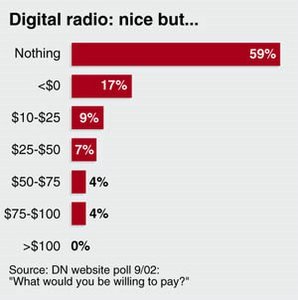

HD Radio-BUZZING DIGITAL DEATH WAIL
HD Radio promises much, but delivers little. Mostly, much more radio interference to both AM and FM listening.
The coverage area is about half of analog radio and it jams more stations then the few new digital streams it creates. HD Radio, iBiquity, IBOC, is the most over-hyped "pet rock" of the new millennium. A total consumer rip off.
iBUZZ is a flawed system that should not be given FCC final approval.
If broadcasters really had all this wonderful new music and information they claim is coming to HD Radio, why wouldn't they just put it on their analog channels where there are actually listeners?
Instead they play the same few dozen tunes "suggested" by large record companies, over and over. Why would HD Radio make a difference?
HD Radio fidelity is about the same as a webstream, artifacts and all.
AM and FM broadcast radio is dieing from the new competition of other media, as well as lack of entertainment value and useful information. The slow death wail of radio broadcasting is iBUZZ.
-WORLDSUPERCASTER
The coverage area is about half of analog radio and it jams more stations then the few new digital streams it creates. HD Radio, iBiquity, IBOC, is the most over-hyped "pet rock" of the new millennium. A total consumer rip off.
iBUZZ is a flawed system that should not be given FCC final approval.
If broadcasters really had all this wonderful new music and information they claim is coming to HD Radio, why wouldn't they just put it on their analog channels where there are actually listeners?
Instead they play the same few dozen tunes "suggested" by large record companies, over and over. Why would HD Radio make a difference?
HD Radio fidelity is about the same as a webstream, artifacts and all.
AM and FM broadcast radio is dieing from the new competition of other media, as well as lack of entertainment value and useful information. The slow death wail of radio broadcasting is iBUZZ.
-WORLDSUPERCASTER
Sunday, April 16, 2006
HD RADIO INTERFERENCE MUCH WORSE-CLEAR CHANNEL SENIOR ENGINEER
Clear Channel senior engineer admits AM HD Radio IBOC interference is much worse then previously calculated.
(FM HD Radio interference is also much worse then measured on a spectrum analyer for the same reasons).
Not -27.8 db for AM but effectively -13.2 db. (Which is the hiss we are all hearing on our radios).
He shows why the spectrum analyzer method is misleading as to the actual effects interference, and calculates the difference, and states Barry McLarnon's calculations of much greater interference are correct. Mr. McLarnon published a series of technical articles published in "Radio Guide" and submitted engineering proofs to the FCC as a reply to HD Radio Docket MM 99-325.
I think this confession by Clear Channel's Senior Vice President of Engineering effectively guts the "all knowledgeable" HD Radio advocates who have been claiming as "fact" IBOC HD Radio causes minimal or no interference.
Of course we knew this all along, just by hearing the hiss on our radios. Never underestimate the human ear as the final test instrument for what humans actually hear.
Spectrum analyzers hear differently with eyballs then humans with ears! Those are the real life "facts."
If radio sounds bad to the ear, no one will listen, regardless of what you see on a spectrum analyzer.
HERE IS THE LINK TO THE FULL REPORT:
http://www.am-dx.com/iboc_power.htm
(FM HD Radio interference is also much worse then measured on a spectrum analyer for the same reasons).
Not -27.8 db for AM but effectively -13.2 db. (Which is the hiss we are all hearing on our radios).
He shows why the spectrum analyzer method is misleading as to the actual effects interference, and calculates the difference, and states Barry McLarnon's calculations of much greater interference are correct. Mr. McLarnon published a series of technical articles published in "Radio Guide" and submitted engineering proofs to the FCC as a reply to HD Radio Docket MM 99-325.
I think this confession by Clear Channel's Senior Vice President of Engineering effectively guts the "all knowledgeable" HD Radio advocates who have been claiming as "fact" IBOC HD Radio causes minimal or no interference.
Of course we knew this all along, just by hearing the hiss on our radios. Never underestimate the human ear as the final test instrument for what humans actually hear.
Spectrum analyzers hear differently with eyballs then humans with ears! Those are the real life "facts."
If radio sounds bad to the ear, no one will listen, regardless of what you see on a spectrum analyzer.
HERE IS THE LINK TO THE FULL REPORT:
http://www.am-dx.com/iboc_power.htm
Wednesday, April 12, 2006
HD RADIO CAUSES INTERFERENCE ON AM AND FM BANDS
MULTIPATH INTERACTION AND CANCELLATION BETWEEN HD DIGITAL AND ANALOG FM SIGNALS DESTROYING FM COVERAGE!
The multipath signal cancellation between digital and analog FM signals not only jams adjacent channel staions but causes additional multipath signal loss to the digital host stations analog signal, and produces digital noise in the analog stereo signal.
In particular, it causes neighboring FM stations to disappear if they are lower-powered or further away (a common experience when listening in the car). For example, when 107.7 in San Francisco turned on IBOC, it made 107.5 from Santa Cruz (the famous KPIG) disappear from the south bay.
In my experience, it also degrades the analog FM signal (of the IBOC broadcaster) with additional multipath.
Here is the link:
http://hardware.slashdot.org/article.pl?sid=06/03/02/187238
HD RADIO-IBOC-Ibiquity should NOT get final FCC approval!
HD RADIO IS A DEFECTIVE, DESTRUCTIVE TECHNOLOGY.
There is no need to approve a defective digital AM or FM system.
Here is a link to a truly compatible FM digital system that dosn't cause jamming and is fully approved RIGHT NOW!
http://www.dreinc.com/
The multipath signal cancellation between digital and analog FM signals not only jams adjacent channel staions but causes additional multipath signal loss to the digital host stations analog signal, and produces digital noise in the analog stereo signal.
In particular, it causes neighboring FM stations to disappear if they are lower-powered or further away (a common experience when listening in the car). For example, when 107.7 in San Francisco turned on IBOC, it made 107.5 from Santa Cruz (the famous KPIG) disappear from the south bay.
In my experience, it also degrades the analog FM signal (of the IBOC broadcaster) with additional multipath.
Here is the link:
http://hardware.slashdot.org/article.pl?sid=06/03/02/187238
HD RADIO-IBOC-Ibiquity should NOT get final FCC approval!
HD RADIO IS A DEFECTIVE, DESTRUCTIVE TECHNOLOGY.
There is no need to approve a defective digital AM or FM system.
Here is a link to a truly compatible FM digital system that dosn't cause jamming and is fully approved RIGHT NOW!
http://www.dreinc.com/
Saturday, April 01, 2006
RADIO STATION OWNERS NEGOTIATE PAYOLA SETTLEMENT!
PAYOLA MAY RUIN PLANS FOR FCC FINAL APPROVAL AND PROGRAMMING OF HD RADIO FOR SOME LARGE BROADCASTERS. NO PAY FOR PLAY ALLOWED.
The nation's biggest radio broadcasters are in discussions with the Federal Communications Commission to resolve accusations that station programmers accepted improper payments from record companies in exchange for playing specific songs, officials involved in the talks said last night.
But the talks have stalled on questions about how much money the companies — Clear Channel Communications, CBS Radio, Entercom Communications and the Citadel Broadcasting Corporation — might have to pay to settle the case, said these officials, who insisted on anonymity because the talks are at a delicate stage.
Clear Channel, which operates about 1,200 stations and is the industry's biggest player, has been pressing for the agency to agree to a range that would place its financial penalty at $1.5 million to $3 million, according to a person involved in the talks. F.C.C. officials had balked at its earlier offers of $500,000 and $1 million, the officials said.
If the two sides do not come to an accord, the agency is expected to start a broad investigation into the payments and request internal documents and e-mail messages from the radio chains.
The companies are trying to avoid the expense — and potential embarrassment — that could arise from an investigation.
The potential stalemate in the settlement talks comes as the F.C.C. has been criticized by the New York attorney general, Eliot Spitzer, for failing to police the radio stations. Mr. Spitzer's office has been conducting an extensive investigation of improper payments — known as payola — in the music industry, and has publicly released reams of internal documents from both record and radio companies illustrating the payments made in exchange for airplay.
Kevin J. Martin, the head of the commission, has said its enforcement bureau would thoroughly investigate accusations of payola.
Links to stories:
http://www.nytimes.com/2006/04/01/business/media/01payola.html?_r=2&oref=slogin&pagewanted=print
http://www.washingtonpost.com/wp-dyn/content/article/2006/03/31/AR2006033101622_pf.html
http://www.latimes.com/entertainment/news/la-fi-payforplay1apr01,0,5789491,print.story?coll=la-home-entertainment
The nation's biggest radio broadcasters are in discussions with the Federal Communications Commission to resolve accusations that station programmers accepted improper payments from record companies in exchange for playing specific songs, officials involved in the talks said last night.
But the talks have stalled on questions about how much money the companies — Clear Channel Communications, CBS Radio, Entercom Communications and the Citadel Broadcasting Corporation — might have to pay to settle the case, said these officials, who insisted on anonymity because the talks are at a delicate stage.
Clear Channel, which operates about 1,200 stations and is the industry's biggest player, has been pressing for the agency to agree to a range that would place its financial penalty at $1.5 million to $3 million, according to a person involved in the talks. F.C.C. officials had balked at its earlier offers of $500,000 and $1 million, the officials said.
If the two sides do not come to an accord, the agency is expected to start a broad investigation into the payments and request internal documents and e-mail messages from the radio chains.
The companies are trying to avoid the expense — and potential embarrassment — that could arise from an investigation.
The potential stalemate in the settlement talks comes as the F.C.C. has been criticized by the New York attorney general, Eliot Spitzer, for failing to police the radio stations. Mr. Spitzer's office has been conducting an extensive investigation of improper payments — known as payola — in the music industry, and has publicly released reams of internal documents from both record and radio companies illustrating the payments made in exchange for airplay.
Kevin J. Martin, the head of the commission, has said its enforcement bureau would thoroughly investigate accusations of payola.
Links to stories:
http://www.nytimes.com/2006/04/01/business/media/01payola.html?_r=2&oref=slogin&pagewanted=print
http://www.washingtonpost.com/wp-dyn/content/article/2006/03/31/AR2006033101622_pf.html
http://www.latimes.com/entertainment/news/la-fi-payforplay1apr01,0,5789491,print.story?coll=la-home-entertainment
Friday, March 31, 2006
HD RADIO-NOT READY FOR PRIME TIME!
EXISTING HD RADIOS MAY SOON BE OBSOLETE!
One of the RIAA's proposals for safeguarding content on HD Radio is encryption at the source, which means that the digital segment of radio transmissions would be scrambled and unable to be heard without special equipment. As you might imagine, the National Association of Broadcasters is not thrilled about the idea. Many of their members have already installed expensive equipment in preparation for the switch to digital broadcasting, and the first HD Radio sets are already on the market. Forcing broadcasters to encrypt their transmission at the source would render all of this equipment obsolete.
Here is the link:
http://arstechnica.com/news.ars/post/20060117-5992.html
One of the RIAA's proposals for safeguarding content on HD Radio is encryption at the source, which means that the digital segment of radio transmissions would be scrambled and unable to be heard without special equipment. As you might imagine, the National Association of Broadcasters is not thrilled about the idea. Many of their members have already installed expensive equipment in preparation for the switch to digital broadcasting, and the first HD Radio sets are already on the market. Forcing broadcasters to encrypt their transmission at the source would render all of this equipment obsolete.
Here is the link:
http://arstechnica.com/news.ars/post/20060117-5992.html
HD Radio-CONSUMER REPORTS PRELIMINARY EVALUATION.
Expect some service interruptions.
We had little trouble tuning in many New York-area HD Radio stations. With some, however, we could receive the analog signal but not the digital one. When the digital signal for the main (HD1) service wasn’t strong enough, the radio efficiently switched to the analog broadcast. Listening wasn’t interrupted, but of course the sound quality reverted back to that of analog radio. When the digital signals faltered for an HD2 subchannel, however, programming simply stopped, resulting in an on/off pattern of interruptions.
Here is the link:
http://www.consumerreports.org/cro/electronics-computers/hd-radio-amfm-goes-digital-306.htm
We had little trouble tuning in many New York-area HD Radio stations. With some, however, we could receive the analog signal but not the digital one. When the digital signal for the main (HD1) service wasn’t strong enough, the radio efficiently switched to the analog broadcast. Listening wasn’t interrupted, but of course the sound quality reverted back to that of analog radio. When the digital signals faltered for an HD2 subchannel, however, programming simply stopped, resulting in an on/off pattern of interruptions.
Here is the link:
http://www.consumerreports.org/cro/electronics-computers/hd-radio-amfm-goes-digital-306.htm
Monday, March 27, 2006
HD RADIO-DEAF AND DUMB!
WHERE HD RADIO IS CONCERNED, EVEN BROADCASTERS SEEM DEAF AND DUMB!
PICKS UP ONLY 2 HD STATIONS?-"NO PROBLEM"
Bought the Receptor HD - only thing thats pissing me off is the radio really is deaf without a good antenna (and then still it only goes HD on a few stations - WMGK and WAWZ are the ONLY ones I can get in HD - WSNI and WJJZ just flash "HD)" and never go in to HD mode. WOR (AM-HD) I couldn't get either.
But I will say that it does sound fantastic on WMGK and WAWZ - much better than XM. And even in analog mode, the system does sound pretty good. But if I can't get HD stations without using a J-pole antenna, I think that this radio will be a flop...
http://www.radio-info.com/mods/board?Board=hd&Post=689125&page=
''there's a hiss, a hiss that did not exist in the past.''
A growing number of radio listeners are encountering similar interference -- hisses, whistles or static -- on their favorite AM stations. The problem for WTRI began about a year ago, when Bonneville International Corp.'s WTOP, the AM station at 1500, began using a digital signal that interfered with WTRI's analog signal in some broadcast areas.
Here is the link:
http://online.wsj.com/public/article/SB114125971438087021.html?mod=todays_free_feature
PICKS UP ONLY 2 HD STATIONS?-"NO PROBLEM"
Bought the Receptor HD - only thing thats pissing me off is the radio really is deaf without a good antenna (and then still it only goes HD on a few stations - WMGK and WAWZ are the ONLY ones I can get in HD - WSNI and WJJZ just flash "HD)" and never go in to HD mode. WOR (AM-HD) I couldn't get either.
But I will say that it does sound fantastic on WMGK and WAWZ - much better than XM. And even in analog mode, the system does sound pretty good. But if I can't get HD stations without using a J-pole antenna, I think that this radio will be a flop...
http://www.radio-info.com/mods/board?Board=hd&Post=689125&page=
''there's a hiss, a hiss that did not exist in the past.''
A growing number of radio listeners are encountering similar interference -- hisses, whistles or static -- on their favorite AM stations. The problem for WTRI began about a year ago, when Bonneville International Corp.'s WTOP, the AM station at 1500, began using a digital signal that interfered with WTRI's analog signal in some broadcast areas.
Here is the link:
http://online.wsj.com/public/article/SB114125971438087021.html?mod=todays_free_feature
NEW ORLEANS-REBUILD CITIES BELOW SEA LEVEL?
Rebuilding Gulf Coast cities that are below sea level, may be a wasteful, hopeless, endeavor.
By one recent measure, several Greenland ice sheets have doubled their rate of slide, and just last week the journal Science published a study suggesting that by the end of the century, the world could be locked in to an eventual rise in sea levels of as much as 20 ft. Nature, it seems, has finally got a bellyful of us.
Here is "the rest of the story":
http://reference.aol.com/globalwarming/timemagazine?id=20060327120109990001
By one recent measure, several Greenland ice sheets have doubled their rate of slide, and just last week the journal Science published a study suggesting that by the end of the century, the world could be locked in to an eventual rise in sea levels of as much as 20 ft. Nature, it seems, has finally got a bellyful of us.
Here is "the rest of the story":
http://reference.aol.com/globalwarming/timemagazine?id=20060327120109990001
Saturday, March 25, 2006
IBUZZ-THE TRUTH ABOUT HD RADIO-UNMASKED!
IBUZZ HD RADIO-DEFECTIVE TECHNOLOGY!
The most elegant encoding algorithm in the world cannot produce "near-CD quality" sound with such limited bandwidth (considering uncompressed CD audio has a bitrate in excess of 1,400 kbps, HD Radio signals convey less than 10% of the original program audio data).
An HD Radio signal is essentially a hybrid analog/digital signal. Its configuration keeps the analog portion of the signal nearest the center frequency and puts the digital data on "sidebands," which are broadcast at 1/100th the power of the analog signal. Thus listeners should expect the coverage area of multicast channels (especially new secondary channels) to be somewhat limited.
Digital Multicasting Rollout Begins [link to this story]
HD RADIO DEFECTS UNMASKED & GRAPHICALLY EXPLAINED:
http://www.diymedia.net/stuff/fmibochybrid.htm
The most elegant encoding algorithm in the world cannot produce "near-CD quality" sound with such limited bandwidth (considering uncompressed CD audio has a bitrate in excess of 1,400 kbps, HD Radio signals convey less than 10% of the original program audio data).
An HD Radio signal is essentially a hybrid analog/digital signal. Its configuration keeps the analog portion of the signal nearest the center frequency and puts the digital data on "sidebands," which are broadcast at 1/100th the power of the analog signal. Thus listeners should expect the coverage area of multicast channels (especially new secondary channels) to be somewhat limited.
Digital Multicasting Rollout Begins [link to this story]
HD RADIO DEFECTS UNMASKED & GRAPHICALLY EXPLAINED:
http://www.diymedia.net/stuff/fmibochybrid.htm
PAYOLA-WILL FCC NAB BROADCASTERS IN PAY-FOR-PLAY SCHEME?
The concentration of radio ownership has ushered in a new age of payola.
Huge recording labels pay off radio conglomerates to play their most bankable performers. Commercial "talent" is pushed to the top of playlists nationwide, shoving local artists off the airwaves. When labels pay big radio to play their most mainstream acts, independent music suffers and radio choice turns into a mind-numbing race to the bottom.
The FCC and New York Attorney General’s office are now investigating reported payola deals at large recording labels. Attorney General Eliot Spitzer has also subpoenaed the records of nine of the nation's biggest radio station chains and filed a suit against one -- Entercom.
An ‘Arsenal of Smoking Guns’
Sony BMG and Warner Music Group have already agreed to pay more than $15 million for payola abuses after Attorney General Spitzer found they had funneled millions in money and prizes to radio broadcasters. FCC commissioner Jonathan Adelstein told reporters that Spitzer gave the agency “an arsenal of smoking guns” to ramp up enforcement against payola broadcasters. Several days later, FCC Chairman Kevin Martin pledged to do just that.
2005 investigations by the New York Attorney General office have implicated nearly 190 stations in illicit deals with recording giants Sony BMG and Warner Music Group. Most of the stations involved were owned by the biggest corporate radio conglomerates.
Investigations are still underway involving deals between Big Radio and other major labels. Click on the PAYOLA MAP (LINK BELOW) to find a station that is being investigated near you. Call the switchboard and tell the station manager that you are concerned about possible payola violations and will be monitoring their broadcasts to ensure that they follow the law and fulfill their obligation to serve the public.
WILL HD RADIO JUST BE MORE PAY-FOR-PLAY OUTLETS?
The Future of Music Coalition (FMC) has announced its support for the recently revealed FCC investigations into payola allegations via a letter to the Commission. The FMC urges that the investigations be completed before any further rulemakings would be put into place that could allow further radio deregulation, or the granting of additional resources to commercial radio broadcasters during the transition to HD radio. "The payola laws are clear," said FMC executive director Jenny Toomey. "Stations that engage in this practice are putting their licenses at risk. What is unclear for musicians and citizens, however, is whether the laws will be enforced. We hope that the FCC will take the evidence gathered in numerous proceedings and by New York Attorney General Eliot Spitzer to fully investigate these practices and hold bad actors accountable." Furthermore, the FMC also stressed to the FCC that payola cannot be examined outside the context of the drastic consolidation in the radio industry under the 1996 Telecommunications Act. "We're at a critical point in the regulatory landscape," said FMC policy director Michael Bracy. "Congress is working on a revision to the 1996 Telecommunications Act. The FCC is about to re-start media ownership proceedings. Terrestrial radio stations just launched dozens HD radio stations in key markets. We need to make sure that the public airwaves are managed in a way that benefits musicians and citizens." If the allegations of radio payola were found to be true, the FMC advocates that the Commission should pledge to hold those responsible in the radio industry accountable and to take steps to protect and expand non-commercial radio, including low power FM. Furthermore, the FMC said that the Commission should not make any rule changes that could help aid in further consolidation in parallel media markets, including lifting the ban on broadcast-newspaper cross-ownership.
HERE IS THE REST OF THE STORY:
http://www.freepress.net/payola/
http://www.fmqb.com/Article.asp?id=175882
PAYOLA MAP:
http://www.freepress.net/payola/map.php
FCC PAYOLA REGULATIONS:
http://www.fcc.gov/cgb/consumerfacts/PayolaRules.html
Huge recording labels pay off radio conglomerates to play their most bankable performers. Commercial "talent" is pushed to the top of playlists nationwide, shoving local artists off the airwaves. When labels pay big radio to play their most mainstream acts, independent music suffers and radio choice turns into a mind-numbing race to the bottom.
The FCC and New York Attorney General’s office are now investigating reported payola deals at large recording labels. Attorney General Eliot Spitzer has also subpoenaed the records of nine of the nation's biggest radio station chains and filed a suit against one -- Entercom.
An ‘Arsenal of Smoking Guns’
Sony BMG and Warner Music Group have already agreed to pay more than $15 million for payola abuses after Attorney General Spitzer found they had funneled millions in money and prizes to radio broadcasters. FCC commissioner Jonathan Adelstein told reporters that Spitzer gave the agency “an arsenal of smoking guns” to ramp up enforcement against payola broadcasters. Several days later, FCC Chairman Kevin Martin pledged to do just that.
2005 investigations by the New York Attorney General office have implicated nearly 190 stations in illicit deals with recording giants Sony BMG and Warner Music Group. Most of the stations involved were owned by the biggest corporate radio conglomerates.
Investigations are still underway involving deals between Big Radio and other major labels. Click on the PAYOLA MAP (LINK BELOW) to find a station that is being investigated near you. Call the switchboard and tell the station manager that you are concerned about possible payola violations and will be monitoring their broadcasts to ensure that they follow the law and fulfill their obligation to serve the public.
WILL HD RADIO JUST BE MORE PAY-FOR-PLAY OUTLETS?
The Future of Music Coalition (FMC) has announced its support for the recently revealed FCC investigations into payola allegations via a letter to the Commission. The FMC urges that the investigations be completed before any further rulemakings would be put into place that could allow further radio deregulation, or the granting of additional resources to commercial radio broadcasters during the transition to HD radio. "The payola laws are clear," said FMC executive director Jenny Toomey. "Stations that engage in this practice are putting their licenses at risk. What is unclear for musicians and citizens, however, is whether the laws will be enforced. We hope that the FCC will take the evidence gathered in numerous proceedings and by New York Attorney General Eliot Spitzer to fully investigate these practices and hold bad actors accountable." Furthermore, the FMC also stressed to the FCC that payola cannot be examined outside the context of the drastic consolidation in the radio industry under the 1996 Telecommunications Act. "We're at a critical point in the regulatory landscape," said FMC policy director Michael Bracy. "Congress is working on a revision to the 1996 Telecommunications Act. The FCC is about to re-start media ownership proceedings. Terrestrial radio stations just launched dozens HD radio stations in key markets. We need to make sure that the public airwaves are managed in a way that benefits musicians and citizens." If the allegations of radio payola were found to be true, the FMC advocates that the Commission should pledge to hold those responsible in the radio industry accountable and to take steps to protect and expand non-commercial radio, including low power FM. Furthermore, the FMC said that the Commission should not make any rule changes that could help aid in further consolidation in parallel media markets, including lifting the ban on broadcast-newspaper cross-ownership.
HERE IS THE REST OF THE STORY:
http://www.freepress.net/payola/
http://www.fmqb.com/Article.asp?id=175882
PAYOLA MAP:
http://www.freepress.net/payola/map.php
FCC PAYOLA REGULATIONS:
http://www.fcc.gov/cgb/consumerfacts/PayolaRules.html
HD Radio-BROADCAST BULLIES LOBBY FOR DEFECTIVE TECHNOLOGY.
"They got broadcasters across the country to hammer like hell on the Congress and the FCC," says the ex-NABer.
Far more power, however, comes from the fact that the NAB represents owners of just about every large and small broadcast outlet in the country--and you can't get elected if you can't get on the air.
This reality, he says, is why NAB is "one of the most powerful lobbying groups in Washington--and one of the most arrogant."
The fight is a classic case of what economists call "regulatory capture" — when an industry that's regulated by a government agency attempts to use that very agency and those regulations to keep upstarts and competitors at bay. And it's almost always to the detriment of consumers.
"To be blunt, the NAB has power that is not commensurate with the persuasiveness of its arguments." The power comes in part from connections.
If you can't compete, get a bill to outlaw the competition. The NAB may yet win this battle.
Here are the links to "the rest of the story":
http://www.forbes.com/archive/forbes/2004/0906/134.html
http://www.foxnews.com/story/0,2933,124610,00.html
Far more power, however, comes from the fact that the NAB represents owners of just about every large and small broadcast outlet in the country--and you can't get elected if you can't get on the air.
This reality, he says, is why NAB is "one of the most powerful lobbying groups in Washington--and one of the most arrogant."
The fight is a classic case of what economists call "regulatory capture" — when an industry that's regulated by a government agency attempts to use that very agency and those regulations to keep upstarts and competitors at bay. And it's almost always to the detriment of consumers.
"To be blunt, the NAB has power that is not commensurate with the persuasiveness of its arguments." The power comes in part from connections.
If you can't compete, get a bill to outlaw the competition. The NAB may yet win this battle.
Here are the links to "the rest of the story":
http://www.forbes.com/archive/forbes/2004/0906/134.html
http://www.foxnews.com/story/0,2933,124610,00.html
Sunday, March 12, 2006
HD Radio=21st Century Yugo (World's worst auto)?
QUOTES:
Well....... I received my HD Receiver yesterday, :) hooked it up ;) and......... nothing, zilch, nada. :eek: Couldn't even pick up one HD station. :mad: I live about 45 miles south of Indy. I drove North toward Indy and I had to go 15 miles North before I could lock into one. So, thanks to Crutchfields generous return policy, they are taking it back.
The HD signals in Indy must be at a lot lower power than the Analog Signals.
I noticed what people had been talking about concerning the switch in and out between Digital and Analog. It is annoying at best when your on the fringe. Pretty big lag between the two. It's not seamless by any means.
IBOC radio will go the way of AM stereo. I can almost guarentee it. It's too expensive for consumers (a la DTV), and mostly prohibitively (is that a word?) expensive for smaller broadcasters to put on the air. Considering Ibiquity wants royalty fees for broadcasting the technology (upwards of $30-50k/yr), there's very little bennefit there to even think about it. (there are about 3 dozen stations nationwide who had IBOC up and running, and turned it off because it didn't pay for itself).
Of course, you can't sell what people can't hear.
The problem with radio is, they seem to always have to recoup R&D costs.... forever. I'm sure there will be a cyberhome equivalent reciever in time, but hell, even the big names are having trouble getting their product to retailers. Harmon Kardon had a nice reciever at NAB a few years ago with HD radio built in, street date of sometime last june... Price was high (about $900 for a mid-grade box), but still not out of the question. HK never made that box, and pretty much has disavowed all knowlege of it even existing. (But i played with it on the show floor in vegas).
http://www.avsforum.com/avs-vb/showthread.php?t=645944
Well....... I received my HD Receiver yesterday, :) hooked it up ;) and......... nothing, zilch, nada. :eek: Couldn't even pick up one HD station. :mad: I live about 45 miles south of Indy. I drove North toward Indy and I had to go 15 miles North before I could lock into one. So, thanks to Crutchfields generous return policy, they are taking it back.
The HD signals in Indy must be at a lot lower power than the Analog Signals.
I noticed what people had been talking about concerning the switch in and out between Digital and Analog. It is annoying at best when your on the fringe. Pretty big lag between the two. It's not seamless by any means.
IBOC radio will go the way of AM stereo. I can almost guarentee it. It's too expensive for consumers (a la DTV), and mostly prohibitively (is that a word?) expensive for smaller broadcasters to put on the air. Considering Ibiquity wants royalty fees for broadcasting the technology (upwards of $30-50k/yr), there's very little bennefit there to even think about it. (there are about 3 dozen stations nationwide who had IBOC up and running, and turned it off because it didn't pay for itself).
Of course, you can't sell what people can't hear.
The problem with radio is, they seem to always have to recoup R&D costs.... forever. I'm sure there will be a cyberhome equivalent reciever in time, but hell, even the big names are having trouble getting their product to retailers. Harmon Kardon had a nice reciever at NAB a few years ago with HD radio built in, street date of sometime last june... Price was high (about $900 for a mid-grade box), but still not out of the question. HK never made that box, and pretty much has disavowed all knowlege of it even existing. (But i played with it on the show floor in vegas).
http://www.avsforum.com/avs-vb/showthread.php?t=645944
HD Radio-MYTHS AND FACTS
FACTS AND MYTHS ABOUT IBOC-DAB
The broadcast industry continues to spread lies about the alleged “advantages” that the system being pushed by the Federal Communications Commission, the National Association of Broadcasters and the Corporation for Public Broadcasting, IBOC-DAB (In-Band, On-Channel Digital Audio Broadcasting) has over analog radio. Here are the REAL FACTS concerning IBOC-DAB.
MYTH: “IBOC is compatible with our current receivers”
FACT: IBOC-DAB is NOT COMPATIBLE with our current receivers. If you have a station broadcasting in a “hybrid” format (IBOC and analog), the sidebands from IBOC signals waste valuable spectrum space (as we’ll go into detail on later). Remove the superior analog signal, then all you’ll hear is “hash”. It’s the same thing with the European system, Digital Radio Mondiale (DRM). Our current receivers do not have the circuitry to decode the inferior-quality IBOC signals. In other words, if there is a forced conversion to IBOC, then American consumers will have to shell out hundreds (if not thousands) of dollars that they DO NOT HAVE to buy new, inferior receivers. The alternatives are:
1) Require the inclusion of DSP (Digital Signal Processing) circuitry in new analog receivers.
2) Finding a separate band above 1 GHz (1000 MHz) for digital audio broadcasting.
3) Forcing the FCC, NAB and CPB to accept more competition.
MYTH: “IBOC is spectrally efficient”
FACT: IBOC is SPECTRALLY INEFFICIENT. IBOC-DAB, as indicated before, wastes valuable spectrum space. IBOC-DAB, depending on how far you are from a particular station, can waste as much as 100 kHz of valuable spectrum space on the AM dial. As much as 800 kHz of valuable spectrum space is wasted on the FM dial. Take the only St. Louis area AM radio station currently testing this inferior system at this time, KFUO (850 kHz) Clayton, MO. How does KFUO stack up (analog vs. IBOC)? The Results can be found at this link. KMOX is also threatening to go IBOC. How will the potential threat be measured? Five FM stations in St. Louis are also testing IBOC. How do they stack up? The results for the FM dial can be found at this link. Analog broadcasting is more spectrally efficient; only taking up 20 kHz of space on the AM band, and 200 kHz of space on the FM band. Analog radio conserves spectrum space.
MYTH: “IBOC is the only method capable of CD-quality sound”
FACT: C-QUAM AM Stereo and FM Stereo are ALREADY CAPABLE of CD-quality sound. The separation on FM Stereo already rivals those of CDs, while the best-engineered C-QUAM AM Stereo stations also feature sound quality that rivals CDs. IBOC-DAB sounds like an Internet radio station heard via dial-up modem. Analog radio (especially the current FM Stereo and the proven C-QUAM AM Stereo systems) has SUPERIOR AUDIO QUALITY over IBOC-DAB. There is no need for IBOC-DAB.
MYTH: “There is a market for IBOC receivers”
FACT: There is NO MARKET for IBOC-DAB receivers. No audiophile, in his or her right mind, would invest a minimum of U$900 in an inferior IBOC receiver, when top-of-the-line analog receivers are less expensive. IBOC threatens to price many consumers out of the radio marketplace. Unlike DVDs and CDs, the price of IBOC receivers will never come down. We’re seeing this with HDTV: the prices aren’t coming down (the cheapest HDTV set right now is U$700). American consumers, as stated earlier, cannot afford to replace their current receivers. There are already 25 million C-QUAM AM Stereo receivers in the marketplace; there’s room for more. Besides, C-QUAM is less expensive than IBOC, not only for receivers, but also for audio transmission.
MYTH: “The L-Band is not for broadcasting in the U.S.”
FACT: The L-Band (1452-1492 MHz) is ASSIGNED WORLDWIDE to digital audio broadcasting. The current occupants of the L-Band in the United States, the Department of Defense, is in violation of international regulations by using this band for non-broadcast purposes. This is the most appropriate place for digital audio broadcasting in the United States. The FCC can (and MUST) find higher frequencies for the DoD to use.
MYTH: “IBOC will increase a station’s signal coverage area”
FACT: IBOC will SIGNIFICANTLY DECREASE a station’s signal coverage area. Take a look at the FM dial in the St. Louis market. Three stations with decent coverage into the St. Louis area, WIBI (91.1 FM) Carlinville, IL, KTJJ (98.5 FM) Farmington, MO and WSMI-FM (106.1) Litchfield, IL, would suffer severely reduced coverage; in other words, these stations would have their coverage areas reduced by as much as 95%. KTJJ, with 100 kW of power, currently covers a 90-mile radius around the transmitter site near Doe Run, MO. With IBOC, the signal won’t be able to reach Park Hills. WIBI and WSMI-FM, with 50 kW of power, covers a 72-mile radius around their transmitter sites. With IBOC, their signals won’t reach nearby towns. Even the 50 kW AM stations will lose most of their coverage; from 750 miles at night to a round-the-clock radius of only 25 miles. In other words, KMOX wouldn’t be able to reach the western suburbs if they converted to IBOC; something they can do easily now in analog mode. A 1 kW Class D local channel station, such as WESL in East St. Louis, IL, which currently covers a 15-mile radius in analog mode, will cover less than a mile in IBOC mode.
MYTH: “IBOC will make radio better”
FACT: IBOC will make radio MUCH WORSE. Not only will the sound quality of many radio stations degrade, along with signal coverage, but the balance of views and independent voices will be negatively affected. Independently-owned radio stations, many of which currently provide a viable alternative to the uninspired programming on corporate radio, will disappear if IBOC is forcibly implemented. Christian radio is also being threatened by IBOC; many Christian radio stations, which are ministry outreaches rather than businesses, will also go off the air. Most seriously affected will be college radio; these stations provide the only alternatives for young audiences to boring programming on corporate-controlled radio. College radio also provides the only on-air training grounds for future personalities. Many college radio stations won’t be able to afford the IBOC transmitters or exciters that they would be forced to purchase if they are to remain on the air. A good number of them are low-powered (less than 1 kW of effective radiated power); they would not be able to cover areas off campus if they are forced to switch to IBOC.
WHAT’S THE REAL PROBLEM WITH RADIO? The problem with radio is not the technology: IT’S THE PROGRAMMING. Many music formats are intangible (such as Classic Hits, Rhythmic Oldies and Active Rock); the jocks that present the format are not very knowledgeable about the music they play. These same jocks are not knowledgeable about the towns they’re serving. Voicetracking has been the biggest deception to hit radio; this does not deliver listeners. Most of the voicetracked shifts are produced outside the market by jocks who know nothing about the market’s they are supposedly “serving”. In addition, commercial talk radio has veered too far to the extreme right. Air America provides the only liberal talk programming, while NPR’s talk shows are the only centrist talk programs left on radio anywhere. There isn’t enough local-oriented talk on the radio; especially a talk format focused on suburban issues (which so-called “mainstream” talk radio neglects).
XM and Sirius Satellite Radio is the only major competition that has come along since the insipid Telecom Act went into effect, although both channels offer the same old programming. Shortwave broadcasting should be pushed as an alternative to AM and FM radio. The FCC should require that all receivers that receive AM and FM radio that are priced at more than $25 include circuitry for decoding C-QUAM AM Stereo, DSP circuitry, and at least four shortwave broadcast bands (with three bands required: 19, 31 and 49 meters, or 15, 9 and 6 MHz).
Radio is also desperately in need of hiring reforms: the most important reform needed is the abandonment of patronage and cronyism. This policy, also known as “it’s not WHAT you know, it’s WHO you know” has allowed unqualified broadcasters to slip through the cracks. There should also be a limit to the amount of on-air talent a station can bring in from outside the market (especially in Midwestern markets), and through a permanent ban on voicetracking (especially in our nation’s top 100 markets) on FM and more profitable AM stations, the industry will be able to open up the broadcast job market, which is desperately needed to save the medium.
The biggest reform needed is the restoration of ownership limits, which promotes free speech. More owners mean more ideas, more opinions and more variety in programming. It is in the best interests of broadcasting to deconsolidate, not further consolidate.
The FCC, NAB and CPB should be focused more on reforming the business than killing it with this insipid IBOC-DAB plan. Those that support IBOC-DAB should seriously consider LEAVING THE RADIO BUSINESS. They are not real broadcasters. Only those who support improving analog radio are the real broadcasters.
From:
http://www.qsl.net/n0uih/IBOCMythsandFacts/
The broadcast industry continues to spread lies about the alleged “advantages” that the system being pushed by the Federal Communications Commission, the National Association of Broadcasters and the Corporation for Public Broadcasting, IBOC-DAB (In-Band, On-Channel Digital Audio Broadcasting) has over analog radio. Here are the REAL FACTS concerning IBOC-DAB.
MYTH: “IBOC is compatible with our current receivers”
FACT: IBOC-DAB is NOT COMPATIBLE with our current receivers. If you have a station broadcasting in a “hybrid” format (IBOC and analog), the sidebands from IBOC signals waste valuable spectrum space (as we’ll go into detail on later). Remove the superior analog signal, then all you’ll hear is “hash”. It’s the same thing with the European system, Digital Radio Mondiale (DRM). Our current receivers do not have the circuitry to decode the inferior-quality IBOC signals. In other words, if there is a forced conversion to IBOC, then American consumers will have to shell out hundreds (if not thousands) of dollars that they DO NOT HAVE to buy new, inferior receivers. The alternatives are:
1) Require the inclusion of DSP (Digital Signal Processing) circuitry in new analog receivers.
2) Finding a separate band above 1 GHz (1000 MHz) for digital audio broadcasting.
3) Forcing the FCC, NAB and CPB to accept more competition.
MYTH: “IBOC is spectrally efficient”
FACT: IBOC is SPECTRALLY INEFFICIENT. IBOC-DAB, as indicated before, wastes valuable spectrum space. IBOC-DAB, depending on how far you are from a particular station, can waste as much as 100 kHz of valuable spectrum space on the AM dial. As much as 800 kHz of valuable spectrum space is wasted on the FM dial. Take the only St. Louis area AM radio station currently testing this inferior system at this time, KFUO (850 kHz) Clayton, MO. How does KFUO stack up (analog vs. IBOC)? The Results can be found at this link. KMOX is also threatening to go IBOC. How will the potential threat be measured? Five FM stations in St. Louis are also testing IBOC. How do they stack up? The results for the FM dial can be found at this link. Analog broadcasting is more spectrally efficient; only taking up 20 kHz of space on the AM band, and 200 kHz of space on the FM band. Analog radio conserves spectrum space.
MYTH: “IBOC is the only method capable of CD-quality sound”
FACT: C-QUAM AM Stereo and FM Stereo are ALREADY CAPABLE of CD-quality sound. The separation on FM Stereo already rivals those of CDs, while the best-engineered C-QUAM AM Stereo stations also feature sound quality that rivals CDs. IBOC-DAB sounds like an Internet radio station heard via dial-up modem. Analog radio (especially the current FM Stereo and the proven C-QUAM AM Stereo systems) has SUPERIOR AUDIO QUALITY over IBOC-DAB. There is no need for IBOC-DAB.
MYTH: “There is a market for IBOC receivers”
FACT: There is NO MARKET for IBOC-DAB receivers. No audiophile, in his or her right mind, would invest a minimum of U$900 in an inferior IBOC receiver, when top-of-the-line analog receivers are less expensive. IBOC threatens to price many consumers out of the radio marketplace. Unlike DVDs and CDs, the price of IBOC receivers will never come down. We’re seeing this with HDTV: the prices aren’t coming down (the cheapest HDTV set right now is U$700). American consumers, as stated earlier, cannot afford to replace their current receivers. There are already 25 million C-QUAM AM Stereo receivers in the marketplace; there’s room for more. Besides, C-QUAM is less expensive than IBOC, not only for receivers, but also for audio transmission.
MYTH: “The L-Band is not for broadcasting in the U.S.”
FACT: The L-Band (1452-1492 MHz) is ASSIGNED WORLDWIDE to digital audio broadcasting. The current occupants of the L-Band in the United States, the Department of Defense, is in violation of international regulations by using this band for non-broadcast purposes. This is the most appropriate place for digital audio broadcasting in the United States. The FCC can (and MUST) find higher frequencies for the DoD to use.
MYTH: “IBOC will increase a station’s signal coverage area”
FACT: IBOC will SIGNIFICANTLY DECREASE a station’s signal coverage area. Take a look at the FM dial in the St. Louis market. Three stations with decent coverage into the St. Louis area, WIBI (91.1 FM) Carlinville, IL, KTJJ (98.5 FM) Farmington, MO and WSMI-FM (106.1) Litchfield, IL, would suffer severely reduced coverage; in other words, these stations would have their coverage areas reduced by as much as 95%. KTJJ, with 100 kW of power, currently covers a 90-mile radius around the transmitter site near Doe Run, MO. With IBOC, the signal won’t be able to reach Park Hills. WIBI and WSMI-FM, with 50 kW of power, covers a 72-mile radius around their transmitter sites. With IBOC, their signals won’t reach nearby towns. Even the 50 kW AM stations will lose most of their coverage; from 750 miles at night to a round-the-clock radius of only 25 miles. In other words, KMOX wouldn’t be able to reach the western suburbs if they converted to IBOC; something they can do easily now in analog mode. A 1 kW Class D local channel station, such as WESL in East St. Louis, IL, which currently covers a 15-mile radius in analog mode, will cover less than a mile in IBOC mode.
MYTH: “IBOC will make radio better”
FACT: IBOC will make radio MUCH WORSE. Not only will the sound quality of many radio stations degrade, along with signal coverage, but the balance of views and independent voices will be negatively affected. Independently-owned radio stations, many of which currently provide a viable alternative to the uninspired programming on corporate radio, will disappear if IBOC is forcibly implemented. Christian radio is also being threatened by IBOC; many Christian radio stations, which are ministry outreaches rather than businesses, will also go off the air. Most seriously affected will be college radio; these stations provide the only alternatives for young audiences to boring programming on corporate-controlled radio. College radio also provides the only on-air training grounds for future personalities. Many college radio stations won’t be able to afford the IBOC transmitters or exciters that they would be forced to purchase if they are to remain on the air. A good number of them are low-powered (less than 1 kW of effective radiated power); they would not be able to cover areas off campus if they are forced to switch to IBOC.
WHAT’S THE REAL PROBLEM WITH RADIO? The problem with radio is not the technology: IT’S THE PROGRAMMING. Many music formats are intangible (such as Classic Hits, Rhythmic Oldies and Active Rock); the jocks that present the format are not very knowledgeable about the music they play. These same jocks are not knowledgeable about the towns they’re serving. Voicetracking has been the biggest deception to hit radio; this does not deliver listeners. Most of the voicetracked shifts are produced outside the market by jocks who know nothing about the market’s they are supposedly “serving”. In addition, commercial talk radio has veered too far to the extreme right. Air America provides the only liberal talk programming, while NPR’s talk shows are the only centrist talk programs left on radio anywhere. There isn’t enough local-oriented talk on the radio; especially a talk format focused on suburban issues (which so-called “mainstream” talk radio neglects).
XM and Sirius Satellite Radio is the only major competition that has come along since the insipid Telecom Act went into effect, although both channels offer the same old programming. Shortwave broadcasting should be pushed as an alternative to AM and FM radio. The FCC should require that all receivers that receive AM and FM radio that are priced at more than $25 include circuitry for decoding C-QUAM AM Stereo, DSP circuitry, and at least four shortwave broadcast bands (with three bands required: 19, 31 and 49 meters, or 15, 9 and 6 MHz).
Radio is also desperately in need of hiring reforms: the most important reform needed is the abandonment of patronage and cronyism. This policy, also known as “it’s not WHAT you know, it’s WHO you know” has allowed unqualified broadcasters to slip through the cracks. There should also be a limit to the amount of on-air talent a station can bring in from outside the market (especially in Midwestern markets), and through a permanent ban on voicetracking (especially in our nation’s top 100 markets) on FM and more profitable AM stations, the industry will be able to open up the broadcast job market, which is desperately needed to save the medium.
The biggest reform needed is the restoration of ownership limits, which promotes free speech. More owners mean more ideas, more opinions and more variety in programming. It is in the best interests of broadcasting to deconsolidate, not further consolidate.
The FCC, NAB and CPB should be focused more on reforming the business than killing it with this insipid IBOC-DAB plan. Those that support IBOC-DAB should seriously consider LEAVING THE RADIO BUSINESS. They are not real broadcasters. Only those who support improving analog radio are the real broadcasters.
From:
http://www.qsl.net/n0uih/IBOCMythsandFacts/
Saturday, March 11, 2006
RADIO GIANT ENTERCOM NAMED IN PAYOLA LAWSUIT
Entercom Alleged to have Traded Air Time for Payoffs by NY state attorney general.
An Entercom executive responded:
"These are not optional. They come from corporate and generate millions of dollars for Entercom."
Payola is the practice by which record labels and some independent promoters offer money and other gifts in exchange for broadcast air time for particular songs or artists. The purpose of the payments is to increase air time for chosen songs and artists and manipulate the popular music industry charts.
Link to full story:
http://www.oag.state.ny.us/press/2006/mar/mar08a_06.html
Eliot Spitzer only has jurisdiction over New York State, so yes the lawsuit only relates to New York State. However, I direct your attention to page 7 of the 28 page lawsuit. "22. Federal Law also prohibits the undisclosed sale of airplay." And then: "According to the Federal Communications Commission, "payola" statutes are intended "clearly to prevent deception on the part of the public growing out of concealment of the fact that the broadcast of particular program material was induced by consideration received by the licensee."It's impossible for me to read the evidentiary emails without agreeing with Spitzer's conclusion that CD Preview and CD Challenge were thinly veiled, if veiled at all, attempts to circumvent the law. They were clearl attempting to manipulate charts and public opinion. Legal? Perhaps. Perhaps not. Ethical? Absolutely not.
There is ample documentation backing up Universal's claim that Entercom executives knew exactly what was going on the whole time and their feigned shock at what was going on is outrageous. Do read the lawsuit and evidence. It's fascinating.
Quoted from this webpost:
http://www.radio-info.com/mods/board?Post=675601&Board=usa
An Entercom executive responded:
"These are not optional. They come from corporate and generate millions of dollars for Entercom."
Payola is the practice by which record labels and some independent promoters offer money and other gifts in exchange for broadcast air time for particular songs or artists. The purpose of the payments is to increase air time for chosen songs and artists and manipulate the popular music industry charts.
Link to full story:
http://www.oag.state.ny.us/press/2006/mar/mar08a_06.html
Eliot Spitzer only has jurisdiction over New York State, so yes the lawsuit only relates to New York State. However, I direct your attention to page 7 of the 28 page lawsuit. "22. Federal Law also prohibits the undisclosed sale of airplay." And then: "According to the Federal Communications Commission, "payola" statutes are intended "clearly to prevent deception on the part of the public growing out of concealment of the fact that the broadcast of particular program material was induced by consideration received by the licensee."It's impossible for me to read the evidentiary emails without agreeing with Spitzer's conclusion that CD Preview and CD Challenge were thinly veiled, if veiled at all, attempts to circumvent the law. They were clearl attempting to manipulate charts and public opinion. Legal? Perhaps. Perhaps not. Ethical? Absolutely not.
There is ample documentation backing up Universal's claim that Entercom executives knew exactly what was going on the whole time and their feigned shock at what was going on is outrageous. Do read the lawsuit and evidence. It's fascinating.
Quoted from this webpost:
http://www.radio-info.com/mods/board?Post=675601&Board=usa
PAYOLA-FCC REPLY
Thank you for your recent correspondence regarding possible violations of the payola rules by certain broadcasters.
The FCC has longstanding rules prohibiting payola. These rules serve the important purpose of ensuring that the listening public knows when someone is seeking to influence them.We appreciate your views. We are very concerned about the activities that led the New York Attorney General to investigate a number of music companies
and broadcasters, and has resulted in settlement agreements with two music companies to date. The Enforcement Bureau is reviewing these settlement agreements and investigating any incidents in which the agreements disclose evidence of payola rule violations.
Sincerely,
The Federal Communications Commission
The FCC has longstanding rules prohibiting payola. These rules serve the important purpose of ensuring that the listening public knows when someone is seeking to influence them.We appreciate your views. We are very concerned about the activities that led the New York Attorney General to investigate a number of music companies
and broadcasters, and has resulted in settlement agreements with two music companies to date. The Enforcement Bureau is reviewing these settlement agreements and investigating any incidents in which the agreements disclose evidence of payola rule violations.
Sincerely,
The Federal Communications Commission
Friday, March 10, 2006
Major broadcaster Entercom accused of payola.
NY Attorney General Sues Major Radio Chain
Spitzer said listeners and artists are hurt by payola.
"The decisions are being made as to what to put on the airwaves based on bribes to be paid and extracted, rather than on judgments based on artistic merit," he said.
Spitzer said Entercom e-mails he obtained include one from an unidentified executive that stated: "These are not optional. They come from corporate and generate millions of dollars for Entercom."
The lawsuit claims it has evidence in documents and e-mails that executives discussed strategies for supplementing radio station budgets with payola cash from record companies and the independent promoters that act as middle men in the industry.
Here is the link:
http://money.aol.com/news/articles?id=n20060308125409990015
Entercom is a prominent supporter of the HD Radio consortium, and if "pay for play" is their rule, it likely will determine what is on the HD Radio channels.
Spitzer said listeners and artists are hurt by payola.
"The decisions are being made as to what to put on the airwaves based on bribes to be paid and extracted, rather than on judgments based on artistic merit," he said.
Spitzer said Entercom e-mails he obtained include one from an unidentified executive that stated: "These are not optional. They come from corporate and generate millions of dollars for Entercom."
The lawsuit claims it has evidence in documents and e-mails that executives discussed strategies for supplementing radio station budgets with payola cash from record companies and the independent promoters that act as middle men in the industry.
Here is the link:
http://money.aol.com/news/articles?id=n20060308125409990015
Entercom is a prominent supporter of the HD Radio consortium, and if "pay for play" is their rule, it likely will determine what is on the HD Radio channels.
Thursday, March 09, 2006
HD Radio-Touchy subject for supporters.
Perhaps some are oversensitive to legitimate criticism of HD radio. A bit touchy.
My opinion, is that the HD radio is built on a whole series of false premises. There are rational solid reasons for this belief, and it seems to be shared by experiences and opinions of many, as shown by the responses on this discussion board,
http://www.radio-info.com/mods/posts?Board=hd
in engineering publications, and responses to the FCC inquiry about HD Radio, MM Docket No. 99-325.
The facts are, that the FCC AM and FM signal protection specifications were based on experiment and calculation of 2 or more analog signals, not mixed digital and analog signals. To use the same signal standards for mixed analog and additional digital signals on adjacent channels is inacurate. To use the NRSC-5 mask for adjacent channel digital signals without proof that it the digital signals have the same intensity and interference potential as analog signals, is an incomplete, flawed, misrepresentation. As has been stated here, many times, by proponents as well as critics of HD Radio, the digital signal is 100 (or more?) times more powerful and pernicious then an analog signal of the same effective radiated power. That being the case, the digital signal creates more destructive interference. An occasional analog modulation spill over to an adjacent channels at approximately -40 dB, is not the same as a deliberate, continuous, high duty cycle digital signal on the same adjacent channels.
Using analog signal standards for mixed digital and analog signal propagation, may be inaccurate, incomplete, and inappropriate for the current station allocation system. New mixed signal interference studies should be made, including more listening tests on more types of radios, and with more typical listeners.
Secondary coverage is very usefull in the suburbs, when traveling between cities, and in emergencies. It should not be allowed to be reduced or destroyed by HD Radio.
HD Radio's harm to the many far outweighs the benefits and profits of the few.
There should be no rush to adapt a possibly defective and destructive standard, since, in the case of FM, there is a more rational and interference free alternative. Here is one: www.dreinc.com.
Perhaps an alternative AM system under development that would allow night time service and does not need special authorization, should also be examined and evaluated.
There should be no rush to adopt a standard, or endorse and approve an exclusive, expensive, proprietary system, until all alternatives are carefully and fully evaluated. If the wrong system is adopted as the only system for digital broadcasting, we are likely to be stuck with the flawed system's defects for a long time to come. It may totally fail, based on it's inherent flaws.
Haste makes waste.
The frequent claims that only HD Radio proponents have an exclusive patent on the 'truth" and "facts", while all others are ignorant of the "facts" are religious revelations I which choose not to subcribe.
My opinion, is that the HD radio is built on a whole series of false premises. There are rational solid reasons for this belief, and it seems to be shared by experiences and opinions of many, as shown by the responses on this discussion board,
http://www.radio-info.com/mods/posts?Board=hd
in engineering publications, and responses to the FCC inquiry about HD Radio, MM Docket No. 99-325.
The facts are, that the FCC AM and FM signal protection specifications were based on experiment and calculation of 2 or more analog signals, not mixed digital and analog signals. To use the same signal standards for mixed analog and additional digital signals on adjacent channels is inacurate. To use the NRSC-5 mask for adjacent channel digital signals without proof that it the digital signals have the same intensity and interference potential as analog signals, is an incomplete, flawed, misrepresentation. As has been stated here, many times, by proponents as well as critics of HD Radio, the digital signal is 100 (or more?) times more powerful and pernicious then an analog signal of the same effective radiated power. That being the case, the digital signal creates more destructive interference. An occasional analog modulation spill over to an adjacent channels at approximately -40 dB, is not the same as a deliberate, continuous, high duty cycle digital signal on the same adjacent channels.
Using analog signal standards for mixed digital and analog signal propagation, may be inaccurate, incomplete, and inappropriate for the current station allocation system. New mixed signal interference studies should be made, including more listening tests on more types of radios, and with more typical listeners.
Secondary coverage is very usefull in the suburbs, when traveling between cities, and in emergencies. It should not be allowed to be reduced or destroyed by HD Radio.
HD Radio's harm to the many far outweighs the benefits and profits of the few.
There should be no rush to adapt a possibly defective and destructive standard, since, in the case of FM, there is a more rational and interference free alternative. Here is one: www.dreinc.com.
Perhaps an alternative AM system under development that would allow night time service and does not need special authorization, should also be examined and evaluated.
There should be no rush to adopt a standard, or endorse and approve an exclusive, expensive, proprietary system, until all alternatives are carefully and fully evaluated. If the wrong system is adopted as the only system for digital broadcasting, we are likely to be stuck with the flawed system's defects for a long time to come. It may totally fail, based on it's inherent flaws.
Haste makes waste.
The frequent claims that only HD Radio proponents have an exclusive patent on the 'truth" and "facts", while all others are ignorant of the "facts" are religious revelations I which choose not to subcribe.
Tuesday, March 07, 2006
HD Radio-"CD QUALITY" SHOWN TO BE FALSE!
HD RADIO CLAIMS OF "CD QUALITY" SHOWN TO BE FALSE!
Shown below are the results of the European Broadcasting Union tests of the codec licensed by www.ibiquity.com for HD Radio broadcasts. It is known as HD AAC or AAC PLUS.
While it is argueably the most efficient, and advanced digital codec available, it is not lossless, flawless or distortion and artifact free.
A more accurate claim might be that HD Radio offers "near CD quality" at best.
From: http://www.codingtechnologies.com/products/aacPlus.htm
For proof of iBiquity HD Radio licensing info: http://www.codingtechnologies.com/partners/index.htm
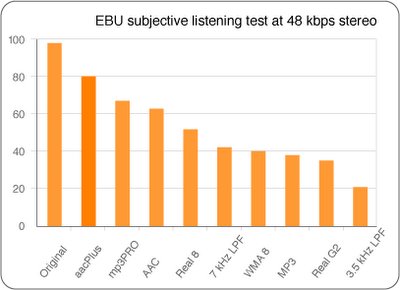
Shown below are the results of the European Broadcasting Union tests of the codec licensed by www.ibiquity.com for HD Radio broadcasts. It is known as HD AAC or AAC PLUS.
While it is argueably the most efficient, and advanced digital codec available, it is not lossless, flawless or distortion and artifact free.
A more accurate claim might be that HD Radio offers "near CD quality" at best.
From: http://www.codingtechnologies.com/products/aacPlus.htm
For proof of iBiquity HD Radio licensing info: http://www.codingtechnologies.com/partners/index.htm

Monday, March 06, 2006
HD Radio-AM Jamming adjacent channel interference.
The grey and dark areas jam and trespass on adjacent stations.
Because of the square wave high duty cycle power of the digital waveforms they create 10 to 100 times more interference and jamming then similar analog signals on the same frequency.
Note the continuous digital hiss and destructive noise created by AM HD radio, that is impressed upon, and can be heard with the analog transmitting station's audio.
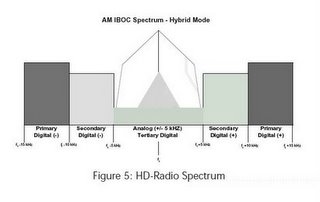

"FCC Audio Division Chief Peter Doyle is quoted by the (Wall Street)Journal as explaining that broadcasters chose to go digital with Ibiquity's technology because it doesn't require new spectrum and that the advantages more than outweigh the shortcomings. Adding digital service is one way to combat the problem, although some small stations can't afford the cost."
The statement that "the advantages more then outweigh the shortcomings" is pure hype, metaphysics and predictive speculation.
The main reason the FCC was established, and it's continuing charge by congress, is to reduce and control interference, not to encourage interference.
All charts are from documents submitted to the FCC for the public record (public domain) by the manufacturers, applicants, and proponents of the HD Radio iBiquty "IBOC" system.
Because of the square wave high duty cycle power of the digital waveforms they create 10 to 100 times more interference and jamming then similar analog signals on the same frequency.
Note the continuous digital hiss and destructive noise created by AM HD radio, that is impressed upon, and can be heard with the analog transmitting station's audio.
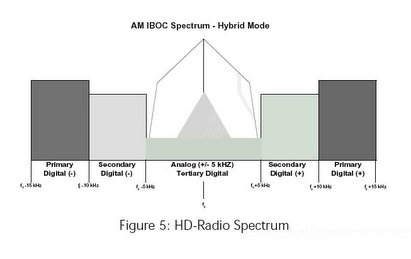
"FCC Audio Division Chief Peter Doyle is quoted by the (Wall Street)Journal as explaining that broadcasters chose to go digital with Ibiquity's technology because it doesn't require new spectrum and that the advantages more than outweigh the shortcomings. Adding digital service is one way to combat the problem, although some small stations can't afford the cost."
The statement that "the advantages more then outweigh the shortcomings" is pure hype, metaphysics and predictive speculation.
The main reason the FCC was established, and it's continuing charge by congress, is to reduce and control interference, not to encourage interference.
All charts are from documents submitted to the FCC for the public record (public domain) by the manufacturers, applicants, and proponents of the HD Radio iBiquty "IBOC" system.
HD Radio FM interference graph
For those with eyes to see, and the wisdom to understand.
BY POPULAR REQUEST!
The BLUE line is the digital interference created by the HD Radio broadcasting station interfering with the FM stereo subcarrier and surrounding FM stations.
GREEN is the reduced stereo signal to noise ratio.
RED -the two verticle lines at the top are the FCC 200kHz maximum limit for an FM station.
Beyond those two verticle RED lines at the top (to the right and left) is all the digital noise and interference created on neighboring channels by the digital signal.
BY POPULAR REQUEST!
The BLUE line is the digital interference created by the HD Radio broadcasting station interfering with the FM stereo subcarrier and surrounding FM stations.
GREEN is the reduced stereo signal to noise ratio.
RED -the two verticle lines at the top are the FCC 200kHz maximum limit for an FM station.
Beyond those two verticle RED lines at the top (to the right and left) is all the digital noise and interference created on neighboring channels by the digital signal.
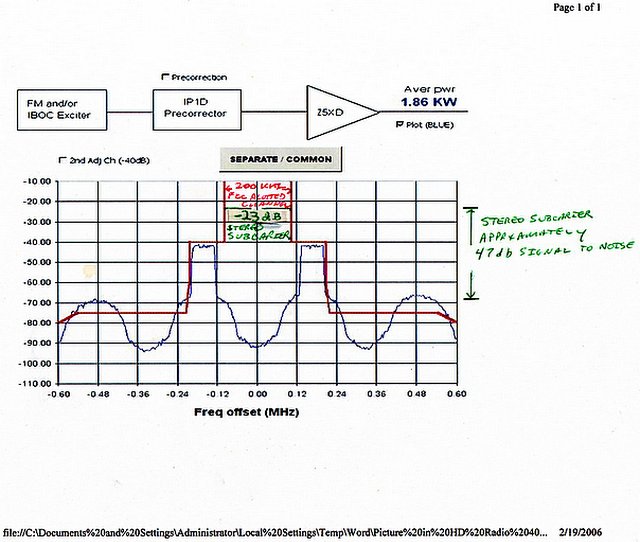
All charts are from documents submitted to the FCC for the public record (public domain) by the manufacturers, applicants, and proponents of the HD Radio iBiquty "IBOC" system.
